
Better Positions, Better Lifts: A Physio’s Guide to Mobility for Strength Training
Every barbell lift requires a specific position. If your ankles, hips, thoracic spine, or shoulders can’t get there, your body finds a way around it. Those workarounds are called compensations, and over time they shift load onto structures that weren’t designed to carry it.
If you lift regularly and your front squat feels restricted or your overhead press stalls before lockout, mobility is worth looking at before you blame strength. Isabelle Chow, our functional fitness and running specialist at Activex Physio and a certified ACE personal trainer and group fitness instructor, put this guide together. Here’s what it covers: what mobility actually is, how limited mobility shows up in the front squat and overhead press, targeted drills for each region, and why drills tend to work better than stretching alone.
What Mobility Actually Is
Mobility gets lumped in with stretching and flexibility, but they’re different things. Flexibility is passive range of motion, how far a joint can move when something else pushes it there, whether that’s gravity, a partner, or a band. Mobility is the ability to actively access and control a position under load.
A lifter who can touch their toes in a forward fold but can’t maintain an upright torso in a front squat has flexibility without mobility. The range of motion exists passively, but the muscles can’t produce or control force through that range when a barbell is involved. That distinction matters because the training response is different: stretching improves the passive range, while drills build the active control you need to actually use it in a lift.
How Compensations Work
When a joint can’t reach the position a lift requires, the body adapts on the fly. Load gets redirected, and joints above or below the restriction take over. A lifter with stiff ankles shifts weight forward onto the toes or cuts depth short. A lifter with tight lats lets the elbows drop in a front rack. The movement still happens, just not the way it was designed to.
Compensations are not inherently bad form. They’re your body solving a problem in real time. But they come with a trade-off: the structures absorbing the redirected load weren’t built to handle it repeatedly under heavy weight. Over weeks and months, that accumulated stress produces overuse, discomfort, and eventually injury risk. The goal is not to eliminate every compensation overnight but to identify what’s limiting the position underneath and address it directly.
Two Lifts Where Mobility Limitations Show Up Clearly
The front squat and the strict overhead press are two of the most mobility-demanding movements in a gym setting. Both require multiple joints to work at end range simultaneously under load, and when mobility falls short in any one area, the compensation is usually visible.
Front Squat
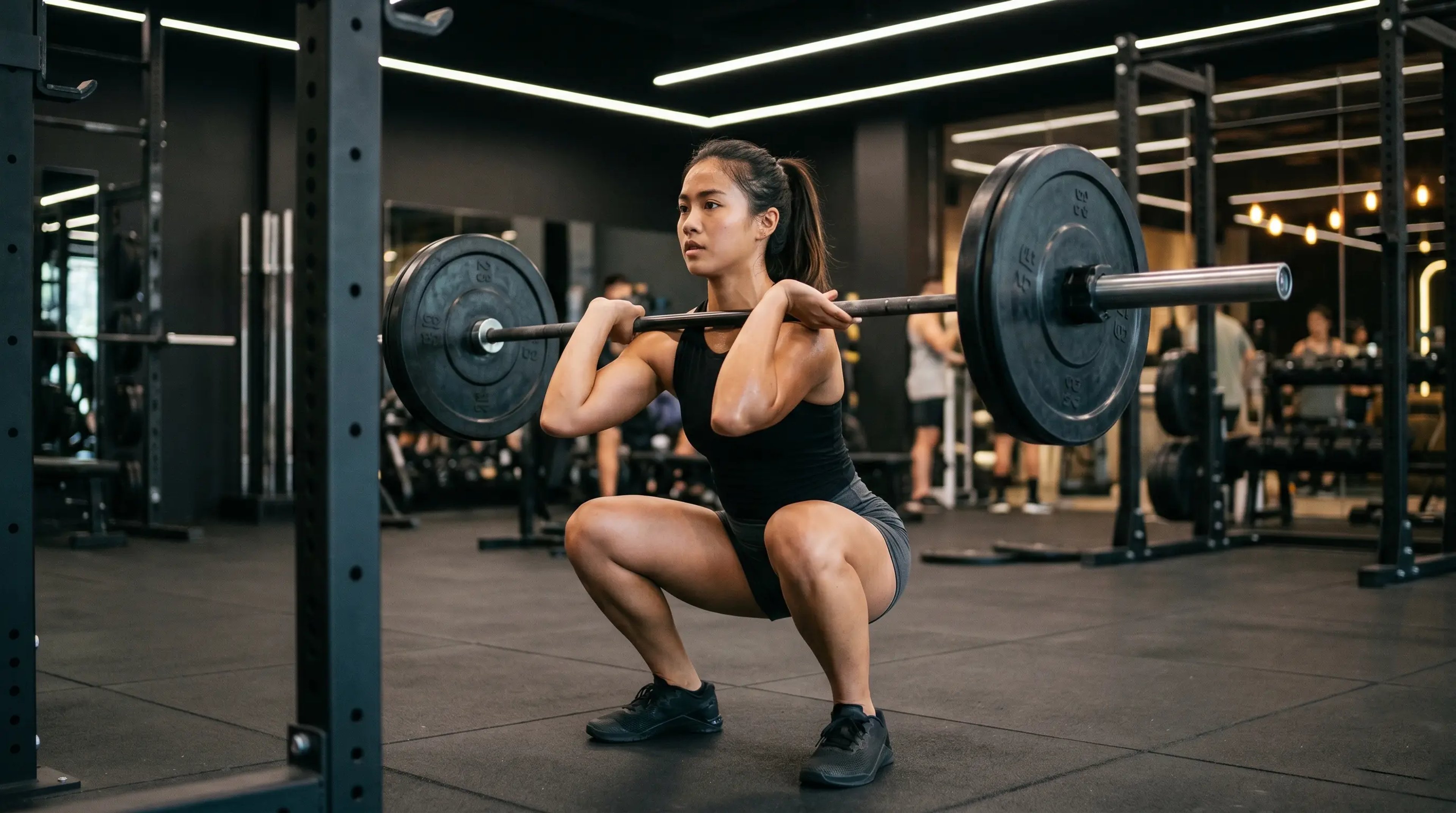
A good front squat position has the elbows high, torso upright, heels flat, and hips below the knee crease with the bar sitting over the midfoot. When mobility is short, several things tend to happen.
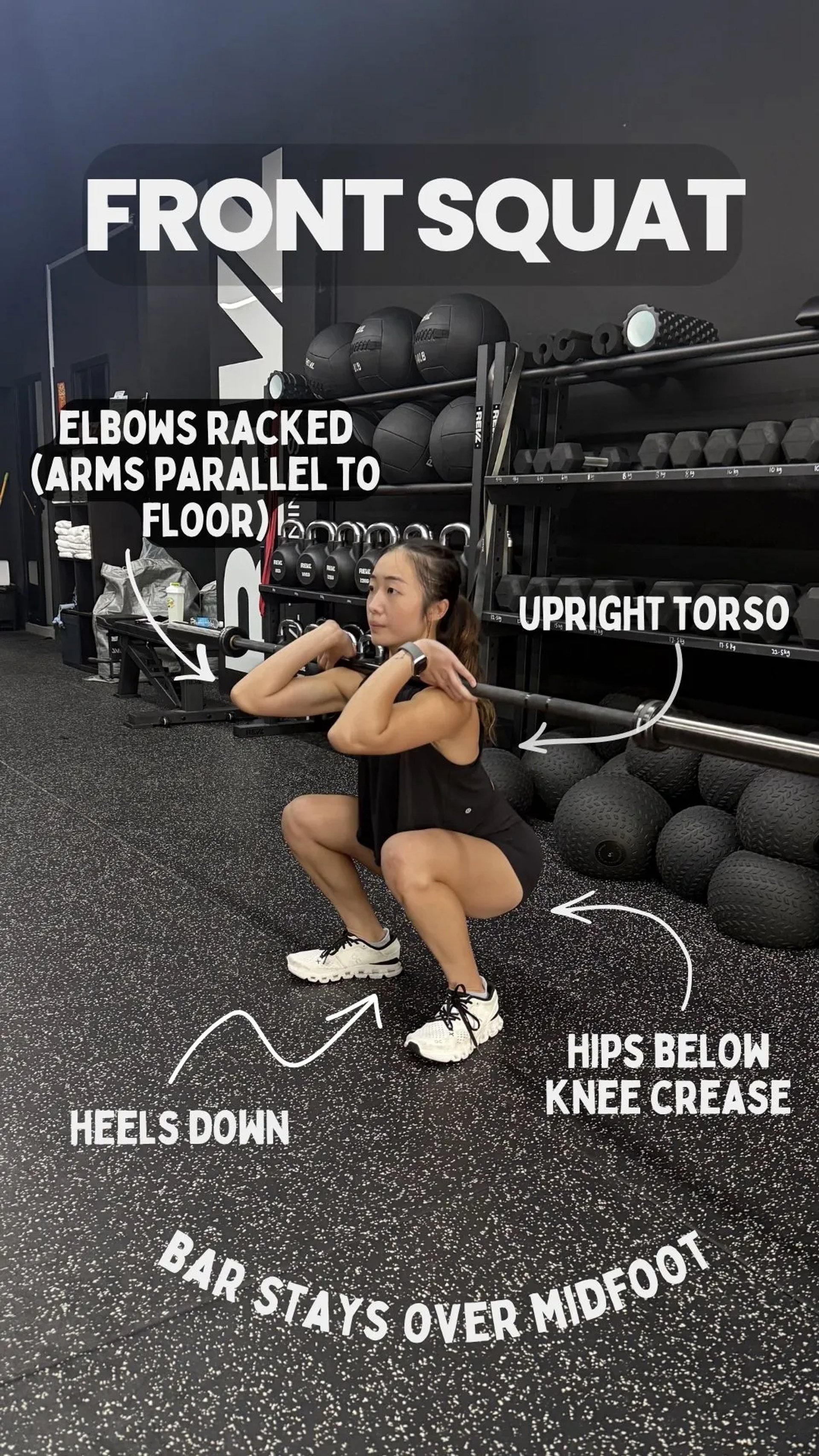
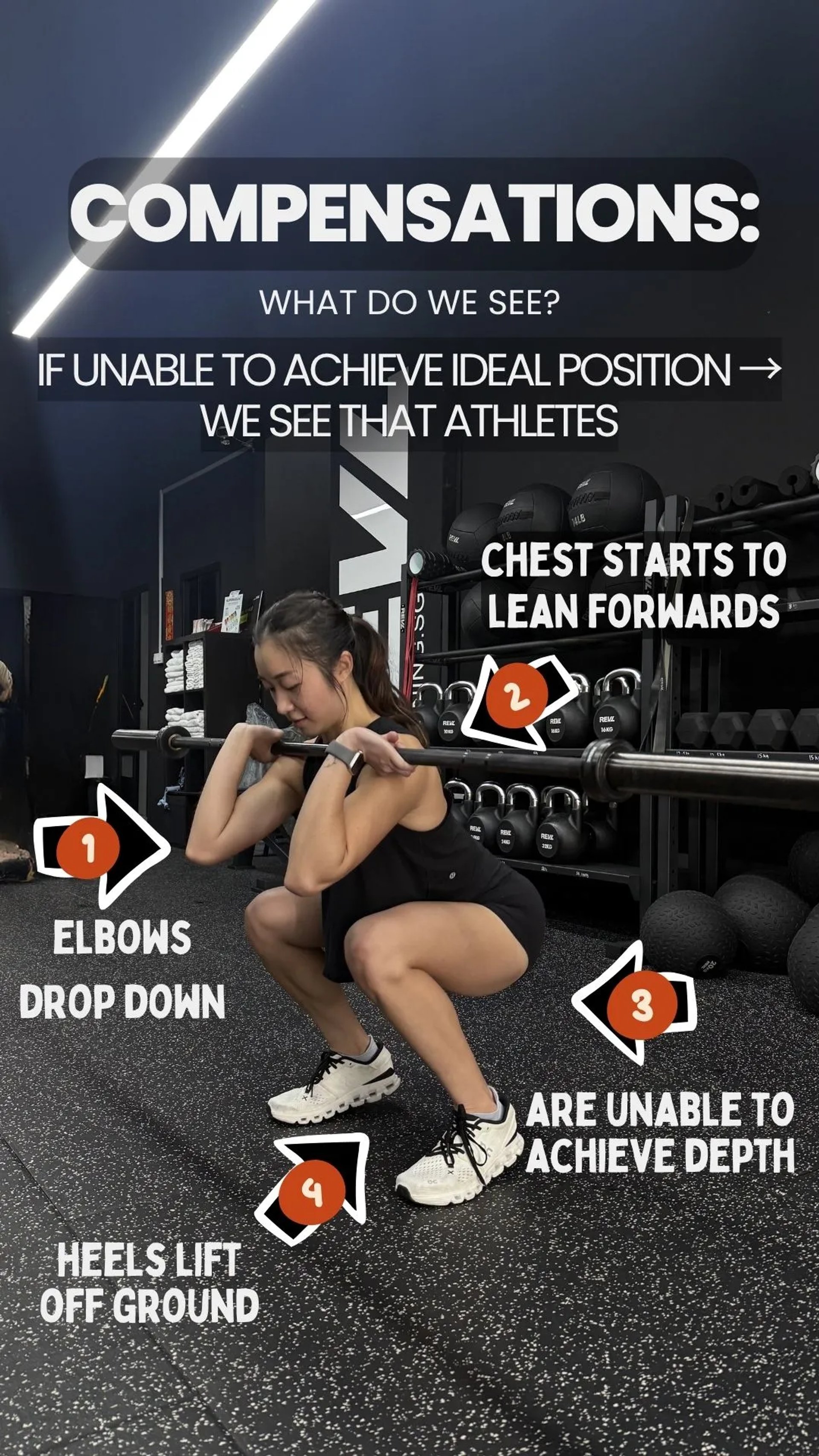
Five areas commonly limit the front squat:
- Lats. Tightness through the lats restricts shoulder flexion, which pulls the elbows down and lets the bar roll forward. This is one of the most common front squat faults and it gets worse as the weight goes up.
- Thoracic extension. When the upper back can’t extend enough, the chest falls forward and the weight shifts anteriorly. The lifter ends up fighting the bar rather than supporting it.
- Ankle dorsiflexion. Restricted ankles force the heels to lift or cut squat depth short. Lifters often don’t realise their depth issue starts at the ankle, not the hip.
- Hip flexion. If the hips can’t flex deep enough, the pelvis tucks early under load, producing what lifters call “butt wink.” Depth is limited regardless of how hard the lifter tries to push through.
- Pecs. Tight pecs pull the shoulders forward, compounding the elbows-dropping pattern. When lats and pecs are both restricted, the front rack position becomes a constant fight.
Any one of these on its own is manageable. When two or three stack up, the front squat becomes a movement where the limiting factor is position, not strength.
Strict Overhead Press
The overhead press demands full shoulder flexion, adequate thoracic extension, and enough pec length to press the bar in a straight vertical line to lockout. A clean lockout has the biceps by the ears, ribs stacked over hips, and minimal lower back arch.
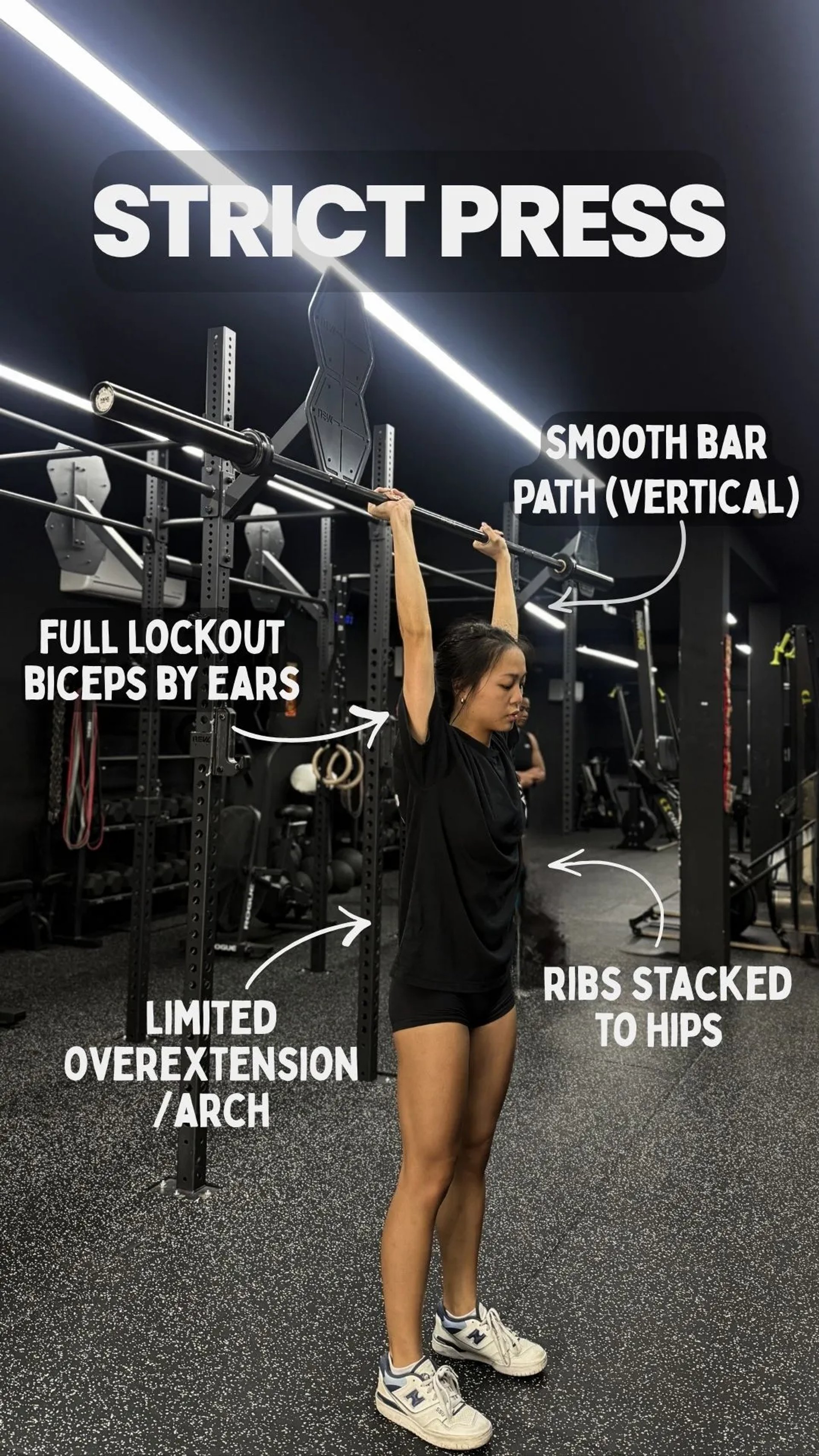
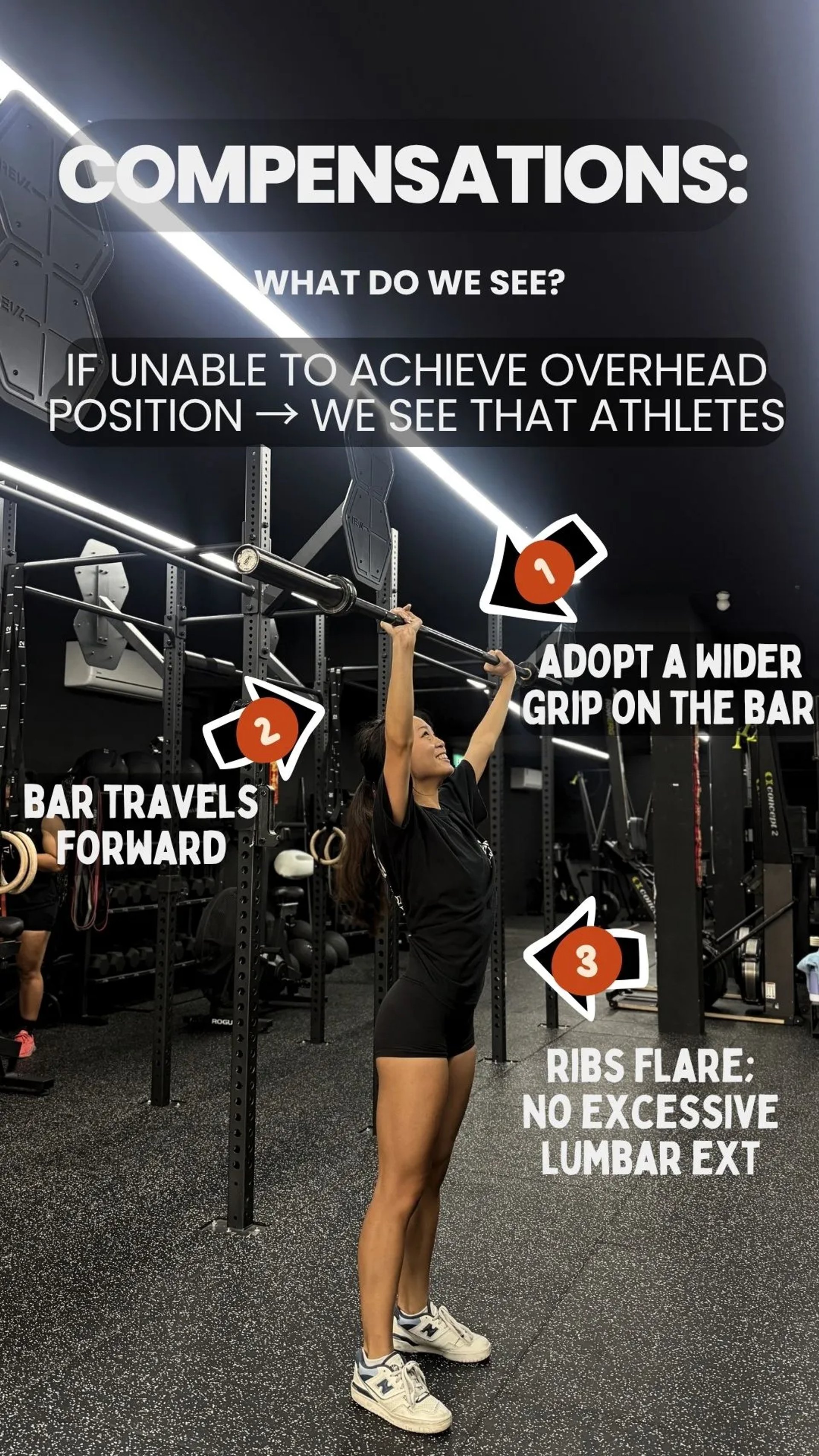
Three areas tend to limit the press:
- Lats. Restricted shoulder flexion pushes the bar path forward rather than straight overhead. The lifter has to work harder to get the bar to the right place, and often can’t.
- Thoracic extension. Without enough upper back extension, the lifter compensates by flaring the ribs or arching excessively through the lower back. Some lumbar extension under heavy load is normal if it’s controlled and pain-free, but when excessive arching becomes the primary strategy for getting the bar overhead, the lumbar spine takes load it shouldn’t be managing.
- Pecs. Anterior shoulder tightness shifts the bar path forward or prevents full lockout. If the lifter can’t get their biceps by their ears at the top, tight pecs are usually part of the picture.
Targeted Mobility Drills by Region
The following drills target the areas most commonly limiting the front squat and overhead press. They focus on active range of motion and control through range rather than passive holds.
Wrists
Front rack positioning demands significant wrist extension, and two drills help build that range.
- Single-arm front rack unders. Position one arm under the barbell in a front rack grip and gently push the wrist into extension using the bar as leverage. 5 to 10 reps each side.
- Double wrist extension rocks. Place both hands flat on the floor with fingers pointing toward you and rock forward gently into wrist extension. 5 to 10 reps.
Thoracic Spine
Thoracic extension keeps the chest upright in a squat and the ribs stacked in a press. Two drills target this directly.
- Weighted thoracic extension (wall). Lie on your back with legs at 90 degrees against a wall. Hold a light weight overhead and allow the upper back to extend over a foam roller or rolled towel positioned at mid-back height. 8 to 10 reps, with the option to hold for two seconds at end range.
- Thoracic extension on bench. Kneel in front of a bench, place your elbows on the bench surface, and sink your chest toward the floor to open the upper back. 8 to 10 reps.
Lats
Lat tightness is the most common driver of elbows dropping in the front squat and bar drift in the press, so this region is worth prioritising.
- Banded lat stretch. Attach a band overhead, grip it with one hand, and step away to create tension. Allow the lat to lengthen as the arm is pulled overhead. 3 sets of 8 to 10 slow reps through range, each side.
- Prayer stretch (with or without PVC pipe). Kneel, extend both arms forward onto the floor or onto a PVC pipe, and sit the hips back while pressing the chest toward the floor. 3 sets of 8 to 10 reps.
Pecs
Anterior shoulder and pec tightness pulls the shoulders forward, contributing to elbows dropping in the front rack and a forward bar path in the press.
- TRX pec hold-relax. Set up in a TRX chest fly position and find the point where you feel tension through the pecs. Gently contract the pecs in that lengthened position for 10 seconds, then relax and sink deeper into the stretch. Repeat 3 to 5 times. The contract-relax cycle builds range more effectively than a static hold alone.
Hips
Hip mobility determines squat depth and pelvic control under load.
- Eccentric hip flexion on bench. Sit on the edge of a bench and slowly lower one leg toward the floor with control. 6 to 8 reps with a 3-second lowering phase, each side.
- Slider hip extension. Place one foot on a slider and extend it behind you while maintaining an upright torso. 6 to 8 reps each side.
Ankles
Ankle dorsiflexion determines whether your heels stay flat in the squat and how deep you can go without compensating at the knee or hip.
- Ankle rockers. Stand in a split stance with one foot forward, knee tracking over the toes. Rock the knee forward past the toes, keeping the heel flat. 10 reps each side.
- Deep squat prying. Sit in a deep squat with elbows inside the knees and gently push the knees outward while keeping the heels flat. This targets both ankle dorsiflexion and hip mobility at the same time.
Why Drills Work Better Than Stretching Alone
If you’re already stretching before sessions and your positions aren’t improving, the issue is likely that static stretching builds range you can’t access under load. Passive stretching does create short-term flexibility gains, and it has a role as a warm-up supplement. But range of motion gained through a hamstring stretch or a doorway pec stretch does not reliably transfer to a front squat or an overhead press with weight on the bar.
Mobility drills focus on moving through range with control. They build the neuromuscular coordination to access and hold the positions that lifts actually demand. A stretch might get your ankle into 10 more degrees of dorsiflexion. A drill teaches your body to use those 10 degrees at the bottom of a squat with 80 kilograms on the bar. Both tools have a place, but if the goal is better positions under load, drills are where the carryover lives.
The Bottom Line
If a lift feels restricted, look beyond strength. A lot of the time, the limiting factor is that you can’t access the position the lift demands and your body is compensating around the restriction rather than through it.
Identify the position you can’t achieve, work out what’s likely limiting it, and apply targeted drills with consistency. The better your mobility, the easier it is to access good positions, and the more efficient your lifts become.
If you want help figuring out what’s limiting your movement or building a mobility plan around your training, you can book in with Isabelle below:

Written by Isabelle Chow | Physiotherapist, Functional Fitness & Running Specialist, Activex Physio Singapore