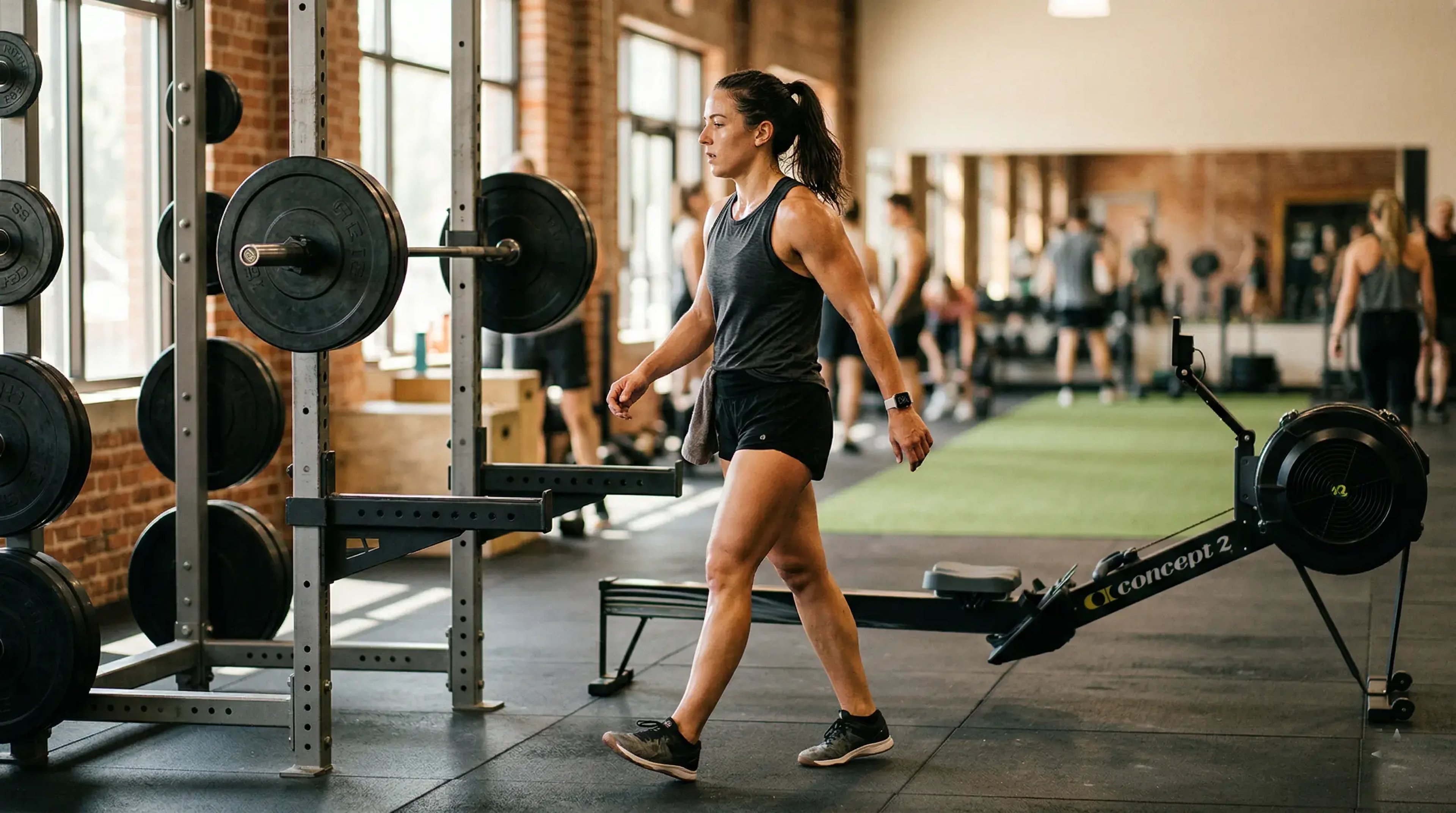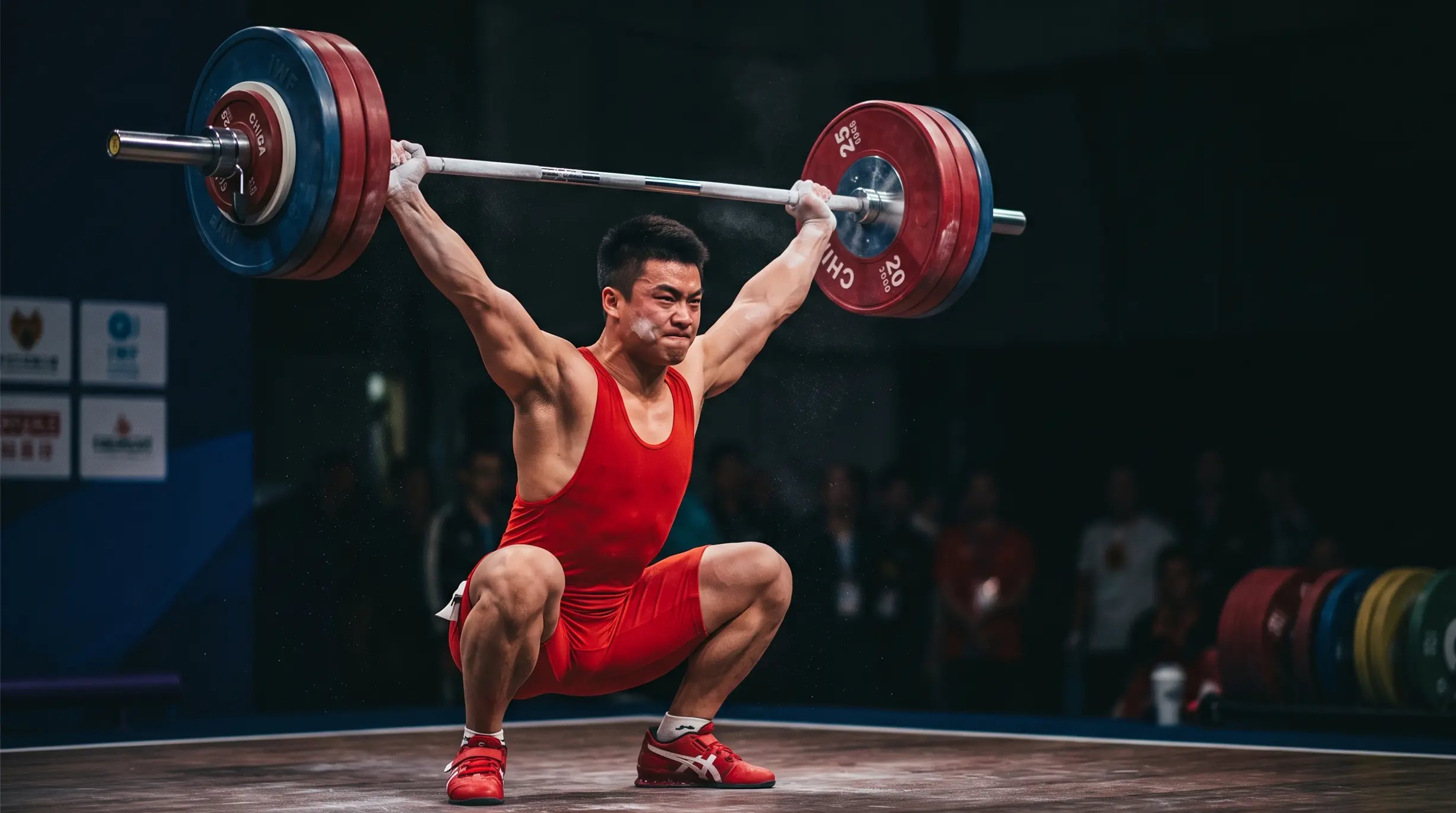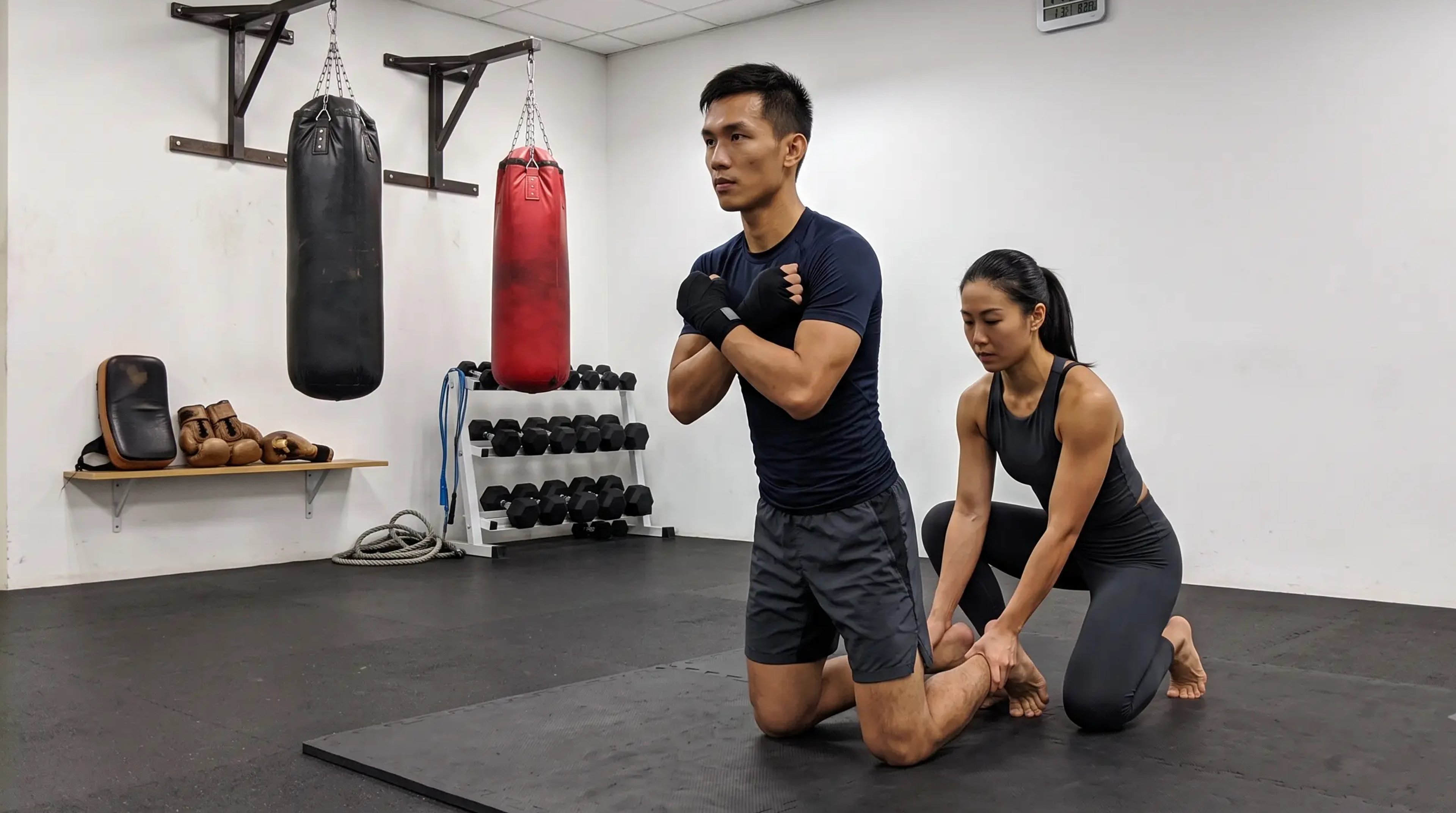

Combat sports put your body through high forces and thousands of repetitive movements, whether you grapple, strike, or train the non-contact forms like wushu and kata. Across three consecutive Olympic Games, Lystad et al. (2021) found combat athletes picked up an injury once every 2.1 hours of competition, and nearly a third of those injuries cost more than seven days away from training. Injuries are common even at the highest level, but common is not the same as unavoidable, and most of what keeps you on the mats is built in the gym rather than hoped for on fight night.
If you train martial arts and want to spend more time training and less time recovering, you'll want to read this guide that Daniel wrote. He's our combat sports specialist, and still fights competitively himself.
Topics covered: why strength training is the foundation of injury prevention, the specific work that protects the neck, knees, and shoulders, and how to program strength, plyometrics, and stretching across a training week.
Why Strength Training Is Your Best Protection
Stronger muscles and tendons do more to lower injury risk than anything else you can train, in combat sports or any sport. When load exceeds what a tissue can handle, something gives, and the muscles around a joint are what raise that ceiling. They offload the forces passing through the joint, stabilize it when you take a strike or collide in a scramble, and control how much power you put into a throw or a punch.
Train the whole body and the protection stacks up across every tissue. Your muscles and tendons resist strain, your bones carry more load before they fracture, your joints stay stable enough to lower the risk of ligament, meniscus, and dislocation injuries, and a stronger neck absorbs force better, which matters for the head and neck more than anywhere else. The honest answer to which muscles you should train is all of them. Full-body strength work is for anyone, not just athletes, and it is still the best way to cut injury risk and raise performance at the same time.
Stronger muscles and tendons are the most effective injury prevention tool you have, because they raise the load your tissues can absorb before something gives.
Two worries stop a lot of people before they start. The first is soreness: if you put real effort in, delayed onset muscle soreness is expected, and it only interferes with your skills training if you push too hard. The goal is a dose that stimulates growth without leaving you wrecked for sparring, the same way many fighters already balance running against their skills work.
The second worry is that lifting makes you slow or stiff. Cid-Calfucura et al. (2023) found structured strength training improved sport-specific performance in judo, boxing, karate, wrestling, and fencing at national and international levels, so actually if anything, the opposite is true. Muscles can shorten a little as they get stronger, which can feel like tightness, but simple stretching and mobility work clears that, and the gains in power and speed are worth the small extra effort.
How to Program Your Strength Work
Lifting heavy with hypertrophy as the goal works best, and a full-body plan of two to three sessions a week with four to five exercises per session covers it. If you are pressed for time, once a week still beats nothing. For hypertrophy, pick a weight that challenges you across 8 to 12 reps for 3 sets, and stop with two to three reps left in reserve. Leaving that buffer also keeps soreness from creeping into your skills sessions.
Compound lifts are the non-negotiables, because they train several muscle groups at once, carry over strongly to sport, and build bone density alongside muscle and tendon strength. Build your sessions around these:
- Bench press. Horizontal pressing strength for the chest, shoulders, and triceps.
- Shoulder press. Overhead pressing that builds the deltoids and stabilizes the shoulder girdle.
- Squat. The foundational lower-body lift for the quads, glutes, and trunk.
- Lunges. Single-leg loading that trains balance alongside strength.
- Deadlift. Any variation loads the whole posterior chain from hamstrings to back.
- Pull-ups. Vertical pulling for the lats and grip.
- Rows. Bent-over rows or T-bar rows for the mid-back and pulling strength.
Targeting the Injuries Combat Athletes Actually Get
Hammami et al. (2018) mapped the common injuries across combat sports: concussions and neck strains at the head and neck, fractures to the hand, forearm, shin, and foot, knee injuries including the ACL, MCL, meniscus, and tendons, and shoulder dislocations and rotator cuff injuries. The compound lifts above cover most of the body, but a few regions earn dedicated work.
The Neck
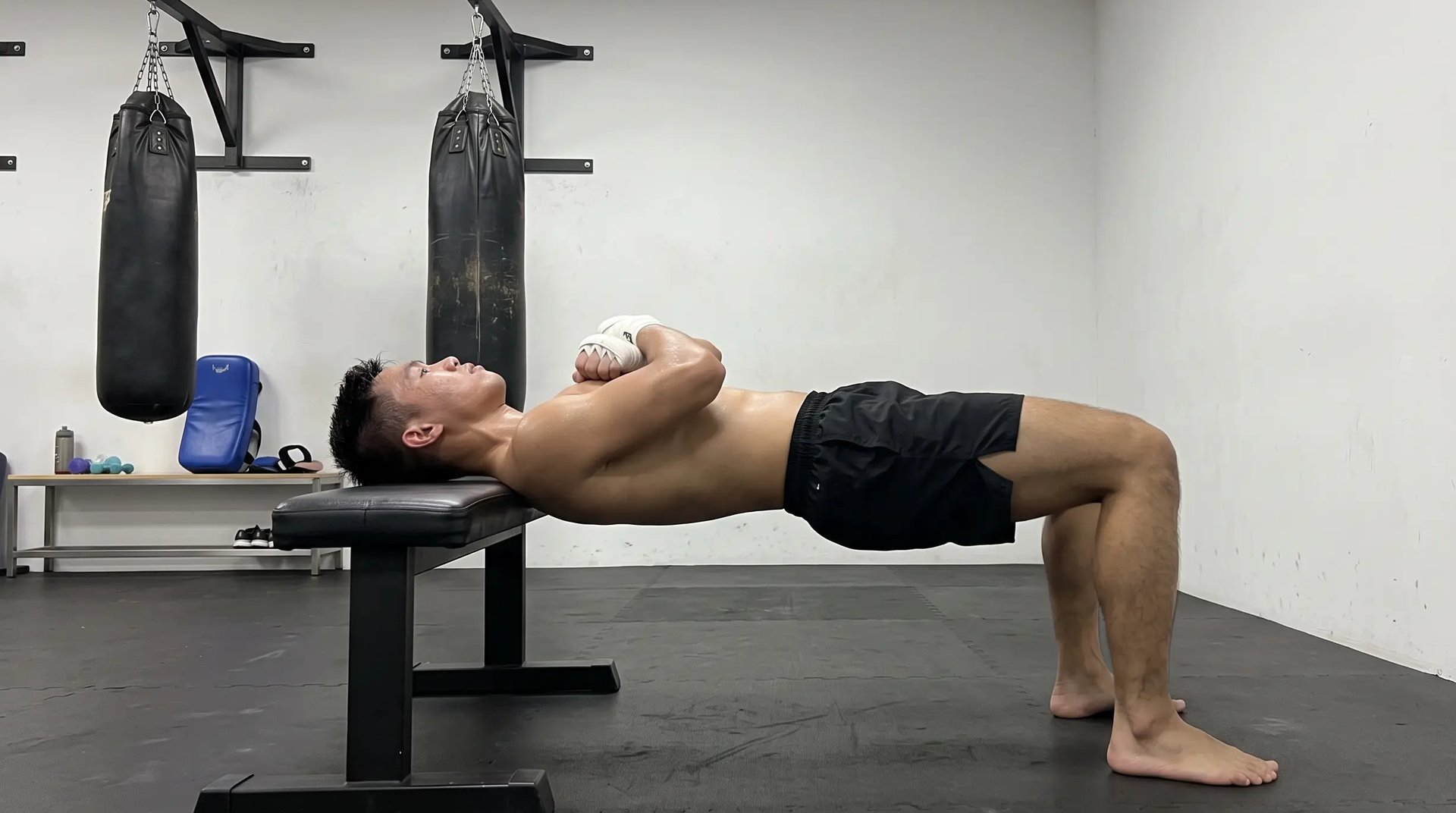
To lower the risk of concussion and neck strains, the neck needs to get stronger at controlling force. Train it through weighted neck extensions, weighted neck flexions, and weighted lateral neck flexions, working the muscles that decelerate the head when it gets hit or whipped around in a scramble.
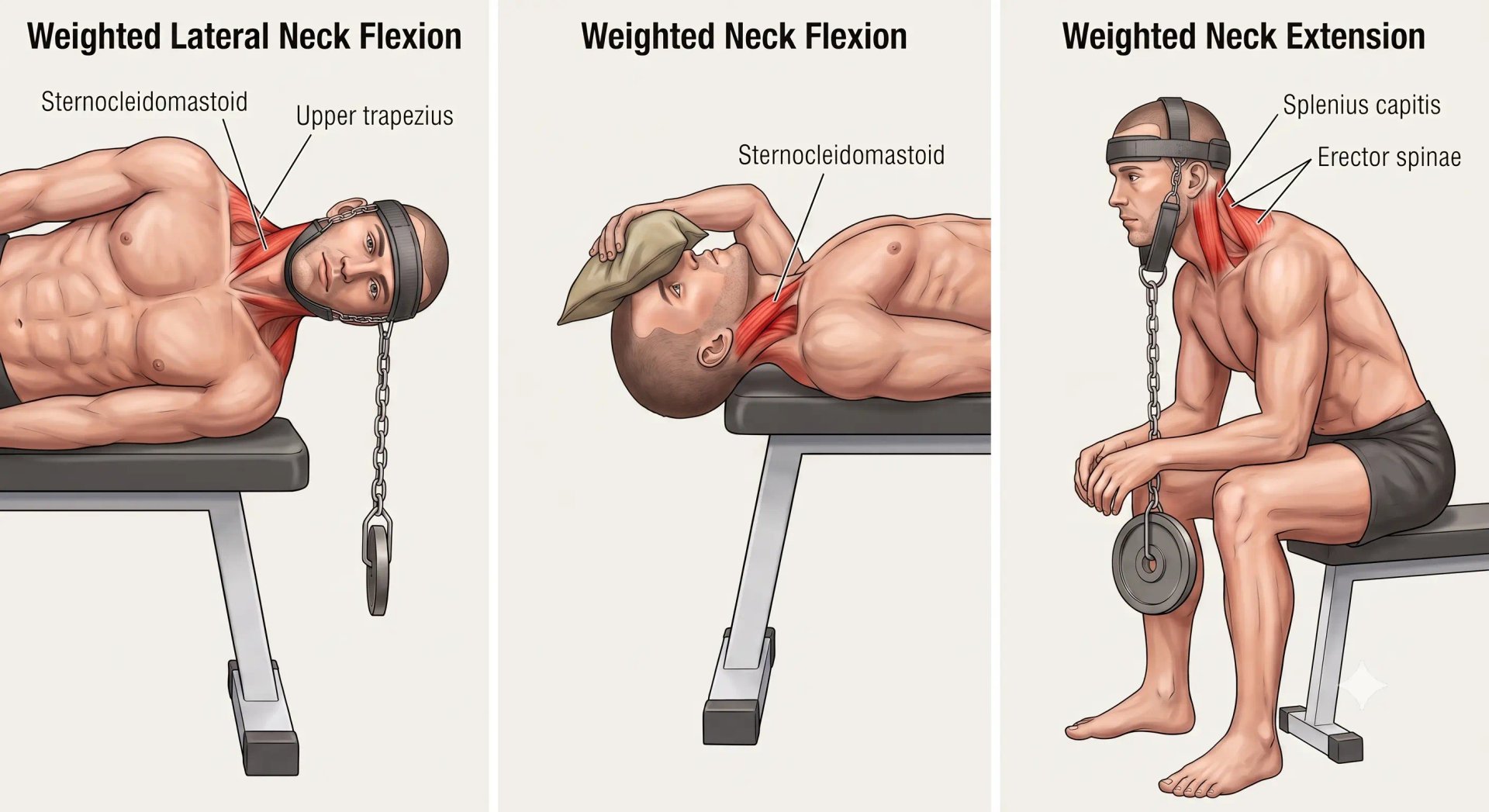
If you have never trained your neck, skip the weight for the first four to six weeks and move through the ranges with just the weight of your head. Add isometric neck planks for all four sides, starting at 3 sets of 30-second holds, and sit on the floor rather than bridging your hips if you are new to it.
A neck that can control and absorb force better is one of the few things that directly lowers the load reaching your brain when you take a hit.
The Knees
Most knee injuries, from the ACL and MCL to meniscus damage and hamstring or quad strains, come down to the knee handling more load than the surrounding muscles can control. Stronger legs also mean more power and speed in your kicks, takedowns, throws, and punches. Three muscle groups carry the knee.
The quads drive knee stability and often settle existing knee pain, so they earn the first slot in your leg work. Pick from either list depending on the equipment you have.
- Weighted. Knee extensions, plus three compounds: barbell front squats, heel-elevated goblet squats, and knee-over-toes lunges.
- Bodyweight. Sissy squats, reverse nordic curls, wall sits, and Spanish squats.
The hamstrings protect against strains and tendon injuries, and for kicks they are often the main limit on speed and power because they eccentrically control the knee straightening out. Load them from either list.
- Weighted. Hamstring curls, RDLs (a compound; go single-leg to train balance), and cable or banded kickbacks.
- Bodyweight. Nordic curls, and single-leg glute bridges as the compound option.
The glutes are overlooked but vital, offloading force from the knee and driving the single-leg control, balance, and hip stability that every kick, throw, takedown, and punch depends on. They give you the widest menu of the three.
- Weighted. Cable or banded leg abductions, plus five compounds: hip thrusts, weighted lunges and step-ups, sumo deadlifts, Bulgarian split squats, and weighted cossack squats.
- Bodyweight. Banded crab walks, and single-leg glute bridges as the compound option.
The Shoulders
Shoulder dislocations, ligament tears, and tendon injuries come from the joint being taken past what it can control, most often in judo, wrestling, and BJJ. The rotator cuff is the key, so train internal and external rotation across a range of shoulder angles. Strong internal rotation with the shoulder raised to 90 degrees in front of you gives you the stability to throw powerful hooks and uppercuts and hold a strong clinch. Strong external rotation lets you navigate clinches, grappling positions, and blocks to the head and body. Do not leave out the deltoids, trapezius, and serratus anterior around the joint.
- Delts. Shoulder press (a compound) and lateral raises with weights, or pike push-ups and hand walkouts at bodyweight.
- Lower traps. Y-raises, underrated and weak in most people. Start at bodyweight and progress to weights.
- Serratus anterior. It matters for punches and breaking your fall. Push-up plus, planche leans, and planche push-ups cover it.
- All ranges. Swimmers build mobility and strength through every angle. Start at bodyweight and progress with light weights.
If your shoulder has already come out or feels unstable in these positions, our shoulder dislocation and instability page covers how we assess and rebuild it.
The Smaller Links
Some of the most injury-prone joints are supported by muscles that rarely get direct work. Train the forearms for wrist and elbow protection with dumbbell wrist curls, wrist extensions, and dead hangs on a pull-up bar. Train the calves and intrinsic foot muscles for ankle protection with weighted single-leg calf raises for the big calf muscles, seated calf raises for the Achilles, banded foot inversions for the arch, and the star excursion balance drill. If you keep rolling the same ankle, our ankle sprain page explains why stability often does not return on its own.
Core training earns its own slot, and it is more than endless situps. Your core wraps the whole spine to stabilize your back and hips, and a stronger one lowers the risk of low back and hip pain while adding power to every kick, punch, and throw.
- Lower back. Bird dogs, any deadlift variation, and back extensions.
- Obliques. Side planks, Pallof press, wood choppers, and cable or banded trunk rotations.
Building the Full Week: Plyometrics and Stretching
Plyometrics are the piece most recreational athletes skip, and they are not only for elite competitors. Any jumping or throwing movement trains the muscles and tendons to transfer force more efficiently, building shock absorption, explosiveness, and speed without adding much body mass (Kons et al., 2023). That lowers the risk of sprains, especially at the ankle, along with fractures and muscle strains.
If your calves are already strong, Booth and Orr (2016) found plyometrics can beat standard strength work for reducing ankle sprains and knee injuries, so the stronger you get, the more they give back. For higher-level athletes there is even more reason to include them, since Ojeda-Aravena et al. (2023) found significant gains in both physical attributes and sport-specific movement across combat athletes who trained them.
Given everything else a fighter does, plyometrics only need one short 10 to 20-minute session a week. Kite and Benstead-Banthorpe (2025) put beginner volume at 80 to 100 reps, intermediate at 100 to 120, and advanced at 120 to 140, spread across 3 to 5 sets with 1 to 2 minutes of rest. Keep them away from the end of a session, because jumping into fatigue raises injury risk rather than lowering it. Work both halves of the body:
- Upper limb. Clapping push-ups; medicine ball throws forward, rotational, and backward; and medicine ball slams.
- Lower limb. Countermovement jumps, standing broad jumps, bounding with single and double-leg hops, single and double-leg pogos, and box, depth, drop, and lateral jumps on one leg or two.
Stretching closes out a session rather than opening it. Always stretch after lifting, not before, since stretching first can cut your strength output. A 5 to 10-minute routine holding each position at least 30 seconds keeps your muscles from shortening to the point where mobility suffers, and some light mobility work before a skills session helps too. Draw from these:
- Upper body. Child's pose, the floor chest stretch, and the crab chest stretch.
- Core and spine. Cobra stretch, mermaid stretch, thread the needle, open books, and supine spinal twists.
- Lower body. Pancake stretch, pigeon pose, sit and reach, Japanese sits, the couch stretch, and the wall calf stretch.
The Bottom Line
Injuries in combat sports are common, but staying on the mats comes down to raising what your body can handle before load exceeds it. Strength training is the foundation, targeted work protects the neck, knees, and shoulders, and plyometrics and mobility round out a week that keeps you training.
Technique matters too, so keep checking in with your coaches on form and fight IQ, since better skills lower your injury risk as much as any lift. A workable week is strength two to three times, plyometrics once, and stretching on your training days. Give it four to six weeks before you expect obvious strength gains, and resist the urge to rush the loads.
If you are already dealing with pain that strengthening is not shifting, or that gets worse when you load it, start there instead of training around it. If you want help building a program that starts where your body is, you can book in with Daniel by clicking the link below:

References
Booth, M.A. and Orr, R. (2016) 'Effects of plyometric training on sports performance', Strength and Conditioning Journal, 38(1), pp. 30-37. doi:10.1519/SSC.0000000000000183
Cid-Calfucura, I. et al. (2023) 'Effects of strength training on physical fitness of Olympic combat sports athletes: a systematic review', International Journal of Environmental Research and Public Health, 20(4), 3516. doi:10.3390/ijerph20043516
Hammami, N. et al. (2018) 'Combat sport injuries profile: a review', Science & Sports, 33(2), pp. 73-79. doi:10.1016/j.scispo.2017.04.014
Kite, R. and Benstead-Banthorpe, J. (2025) 'Understanding plyometrics: a coach's guide', Professional Strength and Conditioning, 73, pp. 20-32. Available at: https://eprints.bournemouth.ac.uk/41079/
Kons, R.L. et al. (2023) 'Effects of plyometric training on physical performance: an umbrella review', Sports Medicine - Open, 9, 4. doi:10.1186/s40798-022-00550-8
Lystad, R.P. et al. (2021) 'Injury incidence, severity and profile in Olympic combat sports: a comparative analysis of 7712 athlete exposures from three consecutive Olympic Games', British Journal of Sports Medicine, 55(19), pp. 1077-1083. doi:10.1136/bjsports-2020-102958
Ojeda-Aravena, A. et al. (2023) 'A systematic review with meta-analysis on the effects of plyometric-jump training on the physical fitness of combat sport athletes', Sports, 11(2), 33. doi:10.3390/sports11020033
Written by Daniel Ng | Physiotherapist, Activex Physio Singapore