
Almost every woman develops some abdominal separation by the end of pregnancy, and the linea alba, the connective tissue running down the middle of your abdomen, stretches to make room. What varies is what happens afterwards.
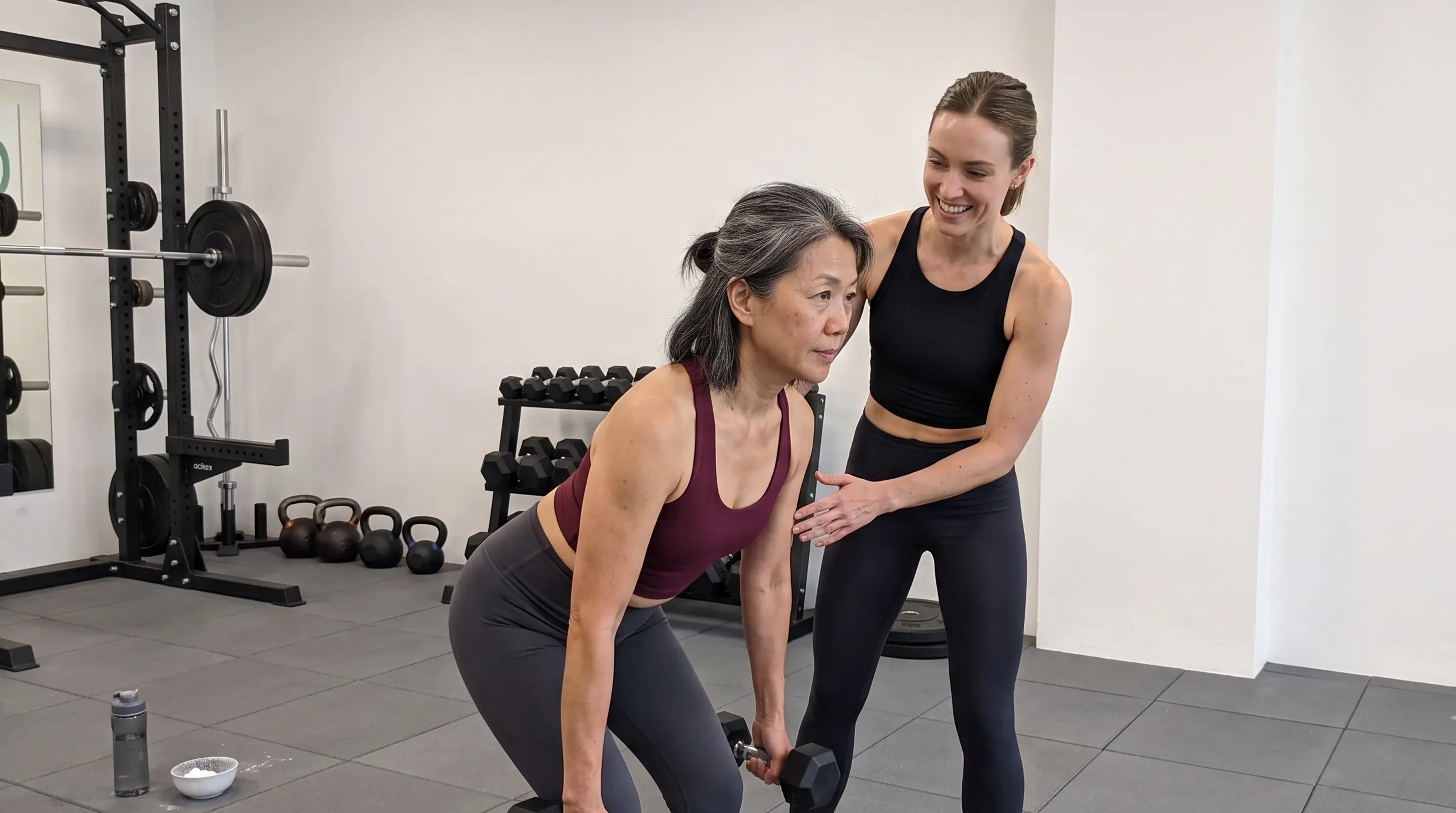
If you are postnatal and staring at a gap down your midline, holding a list of exercises the internet says you can never do again, you'll want to read this guide that Helen wrote. She leads our women's health work and she's an ex-competitive powerlifter who rebuilt her own training after two pregnancies.
Topics covered in this article: what diastasis recti actually is, when to be concerned about how wide the gap is, which of the ‘never-again’ rules the evidence contradicts, a simple check you can do at home, and how a real return to lifting is built.
What Diastasis Recti Actually Is
Diastasis recti is a stretching and widening of the linea alba that lets the two halves of your rectus abdominis sit further apart than usual. It is not a tear, not a hernia, and not damage in the way an injury is damage. It is what the abdominal wall does to accommodate a growing pregnancy, and by the final weeks of pregnancy close to every woman has it (Mota et al., 2015).
Most of it resolves on its own. Separation is present in around 60% of women at six weeks postpartum, drops to roughly 45% at six months, and sits near 33% at a year (Sperstad et al., 2016). The fast retraction happens in the first couple of months, and then the pace slows and keeps going quietly for the rest of the first year, unless it’s actively worked on.
If your diastasis recti is greater than 2cm and you are symptomatic, then that is something to work on. The 2cm line most women get measured against came from women who had never been pregnant. Beer et al. (2009) scanned 150 of them and put the normal linea alba at up to 2.2cm at the usual measuring point above the belly button.
What matters more than the size of the gap is whether the linea alba can hold tension and transfer force across your midline when you load it. A slightly wider midline that stays taut under effort does its job better than a narrow one that goes slack and domes (Lee and Hodges, 2016).
The width of the gap tells you far less about your recovery than whether your midline can hold tension and transfer force when you load it.
The ‘Never-Again’ List Is Mostly Wrong
You have probably been told never to do some exercises. Truth is - exercises are fine; it's how they're performed that makes them good or bad. When performing any abdominal exercise, the goal should be to engage the deep core. No bulging, doming, or coning should be present.
“Never do crunches or curl-ups again”
This is the instruction most women get, and it is the one with the clearest evidence against it. In a controlled trial, postnatal women were split into a group that did nothing but curl-ups and a group told to avoid them. Twelve weeks later the curl-up group had thicker, stronger abdominal muscles, and their separation had not widened (Gluppe et al., 2023). Curl-ups load the abdominal wall, and a postnatal abdominal wall, like any tissue, gets stronger when you load it.
Women who did nothing but curl-ups for twelve weeks got measurably stronger without their gap widening.
“Planks will make it worse”
Planks ask the abdominal wall to resist your bodyweight without letting the midline sag, which is exactly the demand it needs to relearn. Progressed sensibly, from a short hold to longer and harder variations, they build that control rather than damaging anything. The caution people remember comes from watching the midline dome outward during a plank, and that doming is a signal to regress the exercise or coach the brace, not a reason to strike the movement off the list.
“The goal is to close the gap”
Chasing gap closure is chasing the wrong target. The most rigorous trials of gentle, deep-core-only programs, the ones built specifically to narrow the separation, found no meaningful difference in gap width against doing nothing at all after several months (Gluppe et al., 2018).
The goal is to make the core functional, and function responds to load.
“Breathing exercises will fix it”
Diaphragmatic breathing has a role early on, and learning to manage pressure through your midline is a genuine first step. But breathing alone does not rebuild an abdominal wall. The structural change, thicker muscle and a linea alba that tolerates real force, comes from progressive resistance, not from breath work (Benjamin et al., 2023).
A Check You Can Do at Home
You do not need to measure finger-widths. What tells you more is how your midline behaves under a small demand.
Lie on your back with your knees bent, place a hand flat over your belly button, and slowly lift your head and shoulders off the floor as if starting a curl-up. Feel and watch the midline as you rise.
What you are looking for: A midline that stays flat or firms up under your hand is managing pressure well. A midline that pushes up into a ridge or cones outward is a sign the linea alba is not yet tensioning under that load, which means the exercise needs regressing or your brace needs coaching, not that you should stop. It is a guide to where to start, not a diagnosis, and it is worth having a physio confirm what you are feeling.
How the Return to Lifting Is Actually Built
Rebuilding after diastasis recti follows the same logic as rebuilding any tissue: start at a load the structure can currently control, and add demand as it earns it. The stages are not tied to the calendar.
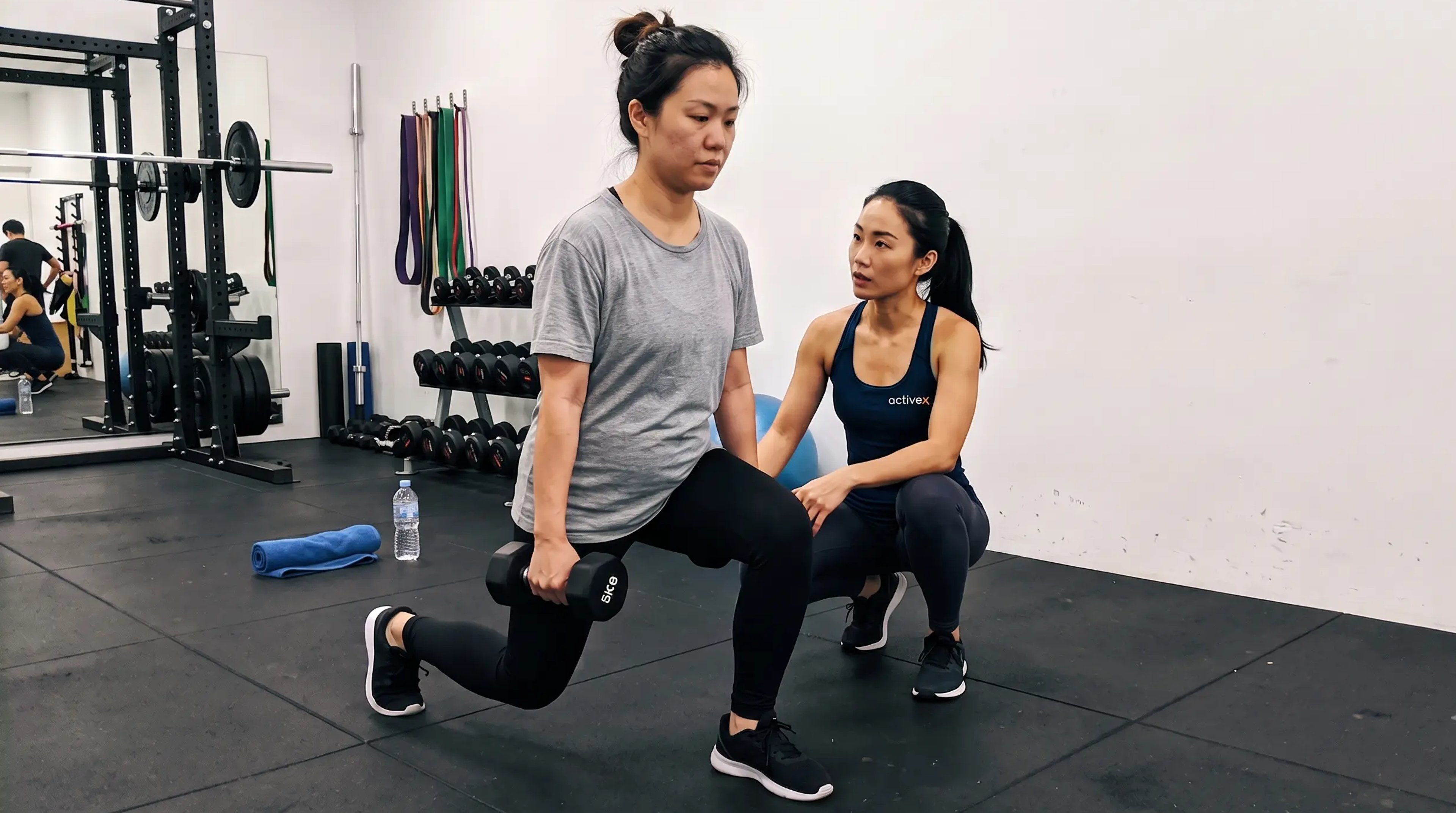
The starting point is wherever your abdominal wall can keep the midline tensioned. For one woman that is a controlled curl-up, for another a loaded carry or a deadbug. From there the demand climbs: heavier carries, controlled curl-up progressions, then Pilates, weights, barbell work, and running when impact tolerance is there.
How you manage pressure while you lift matters, though here the evidence thins out and clinical reasoning takes over. The common coaching cue is to breathe out through the effort so the deep abdominal muscles and pelvic floor engage together and hold the midline, rather than holding a full breath and bearing down against it. Whether a hard breath-hold under a maximal barbell is safe for a postnatal midline has not been properly studied, so the sensible path is to earn heavy bracing gradually once you can transfer load without the midline distorting, not to assume it is off-limits forever (Dufour et al., 2019).
Diastasis recti does not, on its own, raise the odds of pelvic floor problems in the general postnatal population (Gluppe et al., 2021). But among women already seeking help for pelvic floor symptoms, the two show up together often (Spitznagle et al., 2007). If you are dealing with leaking, heaviness, or a dragging sensation, that needs specialist pelvic health input alongside the loading work, and it is worth raising early rather than training around it.
The Bottom Line
Diastasis recti is a normal adaptation to pregnancy, and for most women it improves with time and responds to load. The gap you can see matters far less than whether your midline can hold tension and move force when you ask it to, and that capacity is rebuilt the same way any capacity is rebuilt: progressive, tracked, and matched to what your body can currently control. If you just want the short version of whether physio can help with this, our diastasis recti page covers it in a couple of minutes.
If you have been circling the same short list of gentle exercises and feel like you are not getting anywhere, the missing piece is usually load. Added in the right order, and progressed as your midline earns it, that is what moves the needle.
Start by finding the hardest thing you can do while keeping your midline flat, and build from there.
If you want eyes on where your core is right now and a clear picture of what it can handle, you can book in with Helen by clicking the link below:

References
Benjamin, D.R. et al. (2023) ‘Conservative interventions may have little effect on reducing diastasis of the rectus abdominis in postnatal women: a systematic review and meta-analysis’, Physiotherapy, 119, pp. 54-71. doi:10.1016/j.physio.2023.02.002
Beer, G.M. et al. (2009) 'The normal width of the linea alba in nulliparous women', Clinical Anatomy, 22(6), pp. 706-711. doi:10.1002/ca.20836
Bixo, L. et al. (2022) ‘Association between inter-recti distance and impaired abdominal core function in post-partum women with diastasis recti abdominis’, Journal of Abdominal Wall Surgery, 1, 10909. doi:10.3389/jaws.2022.10909
Dufour, S. et al. (2019) ‘Establishing expert-based recommendations for the conservative management of pregnancy-related diastasis rectus abdominis: a Delphi consensus study’, Journal of Women’s Health Physical Therapy, 43(2), pp. 73-81. doi:10.1097/JWH.0000000000000130
Gluppe, S., Engh, M.E. and Bø, K. (2021) ‘Women with diastasis recti abdominis might have weaker abdominal muscles and more abdominal pain, but no higher prevalence of pelvic floor disorders, low back and pelvic girdle pain than women without diastasis recti abdominis’, Physiotherapy, 111, pp. 57-65. doi:10.1016/j.physio.2020.06.006
Gluppe, S.B., Ellström Engh, M. and Bø, K. (2023) ‘Curl-up exercises improve abdominal muscle strength without worsening inter-recti distance in women with diastasis recti abdominis postpartum: a randomised controlled trial’, Journal of Physiotherapy, 69(3), pp. 160-167. doi:10.1016/j.jphys.2023.05.017
Gluppe, S.L. et al. (2018) ‘Effect of a postpartum training program on the prevalence of diastasis recti abdominis in postpartum primiparous women: a randomized controlled trial’, Physical Therapy, 98(4), pp. 260-268. doi:10.1093/ptj/pzy008
Lee, D. and Hodges, P.W. (2016) ‘Behavior of the linea alba during a curl-up task in diastasis rectus abdominis: an observational study’, Journal of Orthopaedic & Sports Physical Therapy, 46(7), pp. 580-589. doi:10.2519/jospt.2016.6536
Mota, P.G.F. et al. (2015) ‘Prevalence and risk factors of diastasis recti abdominis from late pregnancy to 6 months postpartum, and relationship with lumbo-pelvic pain’, Manual Therapy, 20(1), pp. 200-205. doi:10.1016/j.math.2014.09.002
Sperstad, J.B. et al. (2016) ‘Diastasis recti abdominis during pregnancy and 12 months after childbirth: prevalence, risk factors and report of lumbopelvic pain’, British Journal of Sports Medicine, 50(17), pp. 1092-1096. doi:10.1136/bjsports-2016-096065
Spitznagle, T.M., Leong, F.C. and Van Dillen, L.R. (2007) ‘Prevalence of diastasis recti abdominis in a urogynecological patient population’, International Urogynecology Journal, 18(3), pp. 321-328. doi:10.1007/s00192-006-0143-5
Written by Helen Nguyen (Helen) | Founder & Musculoskeletal Physiotherapist, Activex Physio Singapore