
Running is a very popular form of exercise, and one which we never really get taught how to do. The most common knee pain associated with running is Patellofemoral Pain aka Runner’s Knee.
Patellofemoral pain is caused by a number of factors including overuse which can cause compressive stress to the patellofemoral joint cartilage, patella mal-tracking, and poor motor control (pelvic drop and knee valgus). These are factors we can change with Physiotherapy.
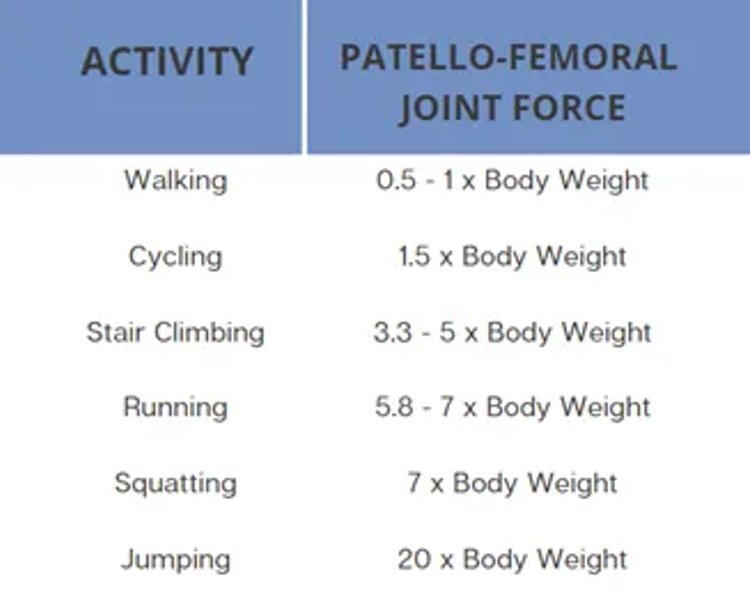
When we run and strike the ground, the ground pushes back on the foot. This force travels up the body, through the knee and patellofemoral joint resulting in a force of approximately 6 times body weight through the joint. If we run an average of 160 steps per minute, that’s 480 body weights per minute, or 28,800 body weights per hour. This explains why a spike in training load can cause Patellofemoral Pain.
Reducing the amount of knee flexion at end of stance phase was the most important predictor of reducing the loading and force through the patellofemoral joint. A one degree increase in peak knee flexion led to a 0.21 x Body Weight increase in patellofemoral force (Lenhart et al., 2014).
By increasing the step rate or cadence by 10%, it’s shown to reduce the amount of knee flexion. Furthermore, a higher cadence reduces the amount of contralateral pelvic drop and knee valgus which reduces the risk of developing patellofemoral pain (Bramah, Preece, Gill and Herrington, 2019).
Take home message:
Increase your running cadence by 10% (ideally 180 steps per minute) to reduce over-striding, pelvic drop and knee valgus. If you’d like an assessment for where you’re at or need some direction, you can book an appointment with our team below:

References:
- Lenhart, R., Thelen D., Wille, C, Chumanov, E and Hediderscheit, B., 2014. Increasing Running Step Rate Reduces Patellofemoral Joint Foraces. Medicine & Science in Sports & Exercise, 46 (3), pp 557-564. fo
- Bramah, C., Preece, S., ,Gill, N. and Herrington, L., 2019. A 10% Increase in Step Rate Improves Running Kinematics and Clinical Outcomes in Runners With Patellofemoral Pain at 4 Weeks and 3 Months. The American Journal of Sports Medicine, 47(14), pp.3406-3413.