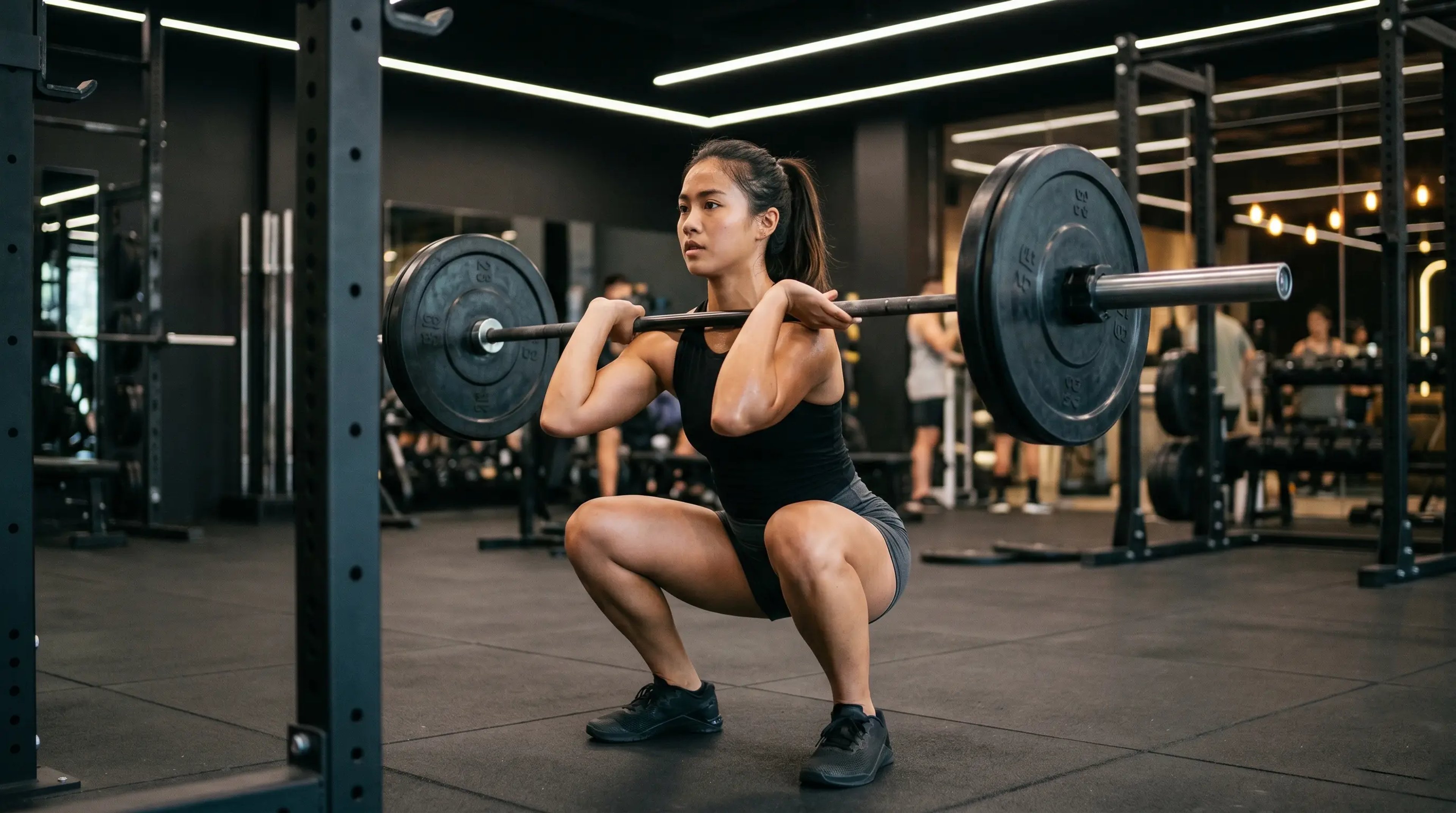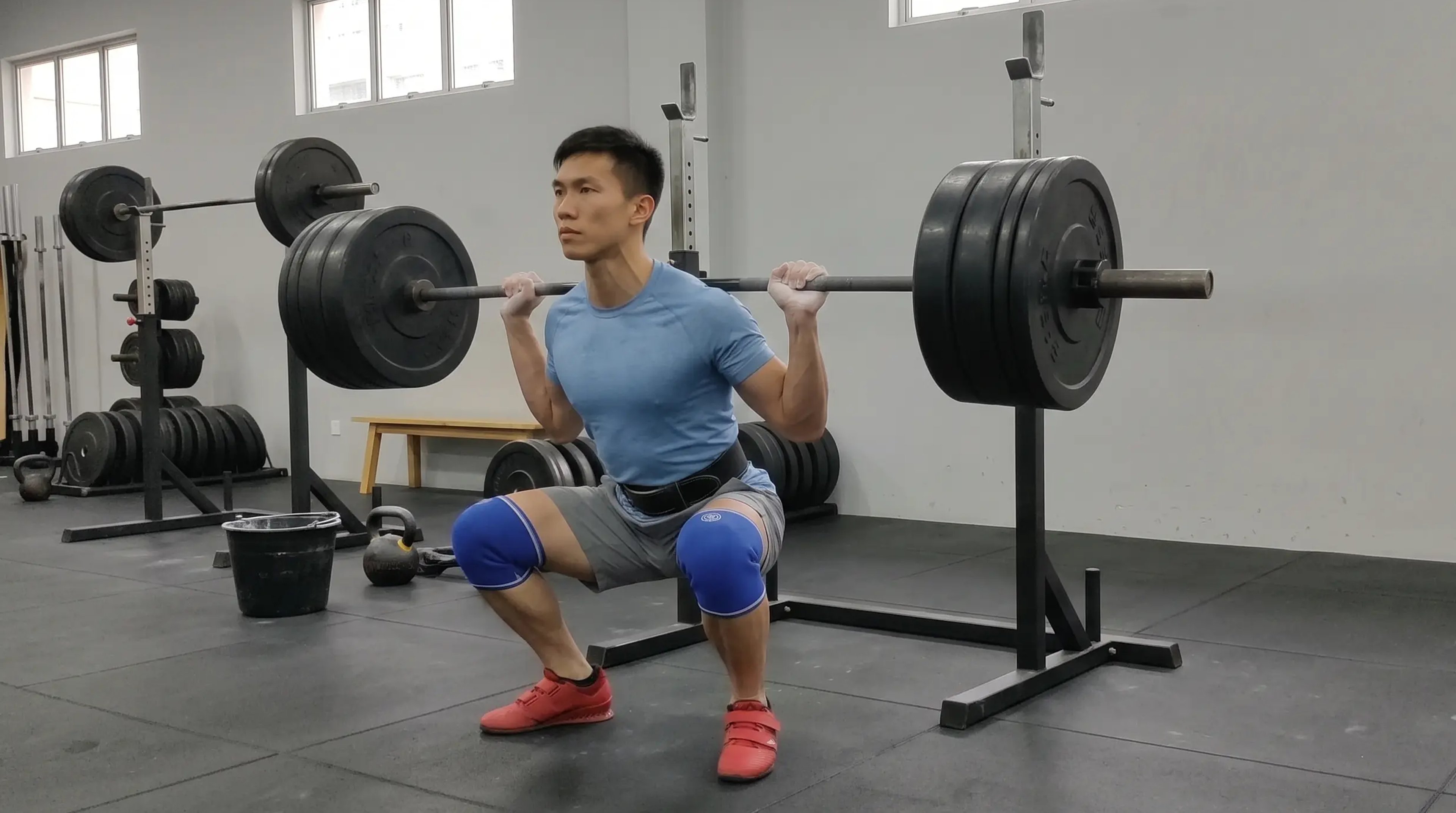

Patellofemoral joint stress increases the deeper you squat, which is why anterior knee pain when squatting tends to show up at depth, coming out of the hole, with more volume or the morning after a heavy session. The knee is rarely where the problem starts. What the ankle, hip and surrounding knee musculature can do under load decides how much the anterior knee has to absorb.
If you squat heavy and the front of your knee has started deciding how deep you go, this article covers what is actually driving it. Helen, our knee and post-surgical specialist, wrote it for lifters in exactly that position. Here’s what it covers: what knee pain when squatting actually is, where the pain comes from, what the evidence says about cueing the knees out, and how the loading is dosed.
What Knee Pain When Squatting Actually Is
Two presentations account for most of it:
- Patellofemoral pain, often called anterior knee pain or runner’s knee, is a diffuse ache around or behind the kneecap that worsens with loaded knee flexion; and
- Patellar tendinopathy, often called jumper’s knee, is sharper and lower, sitting just below the kneecap. It behaves like a tendon problem rather than a joint one.
Both are problems of load intolerance: they appear when the amount, frequency, or speed of loading outruns what the tissue can repair between sessions.
Depth and weight are not the same stress. Bryanton et al. (2012) found that the relative effort demanded of the quadriceps scales with how deep you squat, while the effort demanded of the glutes and calves scales with how heavy the bar is. Past roughly 90 degrees of knee flexion the patellofemoral joint is loaded hardest, so adding depth to a squat usually provokes a sore knee faster than adding weight to the bar.
Depth loads the front of the knee and weight taxes the hip, which makes a deep day and a heavy day two different problems for a knee that has started complaining.
If the short answer is all you need, our knee pain page covers whether physiotherapy helps and what an assessment involves. The rest of this covers the mechanism underneath it.
Where Does the Pain Actually Come From?
Anterior knee pain in lifters rarely originates at the knee itself. The joint sits between an ankle that decides how the shin travels and a hip that decides how the femur (thigh bone) behaves at depth, and it absorbs whatever those two cannot handle. Four things commonly drive it:
- Ankle dorsiflexion. Macrum et al. (2012) restricted dorsiflexion artificially and watched the squat reorganise around it. Medial knee displacement rose sharply, knee flexion dropped, activation of the vastus lateralis fell, and the soleus activation increased. When the shin cannot travel forward over the foot, the knee finds its range sideways instead, and the quadriceps do less of the work they are built for.
- Hip internal rotation. At the bottom of a deep squat the femoral head has to glide backward inside the socket, and that needs internal rotation, not the external rotation you use to open your stance. Kim et al. (2015) found weight-bearing ankle dorsiflexion and hip internal rotation to be the two strongest peripheral predictors of squat depth. Passive hip internal rotation in healthy adults tends to sit somewhere between 31 and 43 degrees, and below that, depth gets borrowed from elsewhere, either the pelvis tucking under at the bottom or a stance opened wider than the lifter actually needs.
- Stance and foot position. Straub and Powers (2024) reviewed the squat literature and found that turning the toes out 30 degrees drops the valgus (knees in) moment at the knee by half while raising the varus moment by 80%, and that a stance beyond about 150% of shoulder width raises the knee valgus moment by 23%. Widening the stance may be shifting the load across the joint instead of taking it off.
- Load history. Volume spikes are the usual trigger, that is moving into a hypertrophy block or into a heavy peaking block. Plyometric work appearing suddenly in a program does the same thing.
Restricting the ankle alone is enough to push the knee inward and quiet the quadriceps.
Restricted ankles and hips are a common pairing in the lifters we see at Activex Physio, plenty of whom go straight from a full day at a desk to a loaded barbell. Because of this, checking hip and ankle range before loading deep squats is an important part of assessment.
What the Evidence Says About Cueing the Knees Out
The instruction to drive the knees out came from anterior cruciate ligament prevention in field sports, where the injury happens during a fast, unloaded deceleration or change of direction. It was then carried across to the barbell squat, which is slow, bilateral, closed-chain, and loaded.
“Any knee that travels inward is collapsing”
Uncontrolled collapse and the brief inward travel that a trained lifter shows near a maximum are two different events. Collapse is a failure of the posterolateral hip to control the femur: the thigh rotates in, the shin abducts, and the foot rolls in. It runs through the whole repetition, start to finish.
The trained pattern appears only at the sticking point of the ascent, usually between 60 and 90 degrees of knee flexion, where the adductor magnus has its best mechanical advantage as a hip extensor. Chiu (2024) measured that demand and found the hip adductor net joint moment sits near 0.3 Nm/kg at 70% of bodyweight, climbing past 0.6 Nm/kg at 70% of a one-repetition maximum. Letting the femur drift in slightly at that moment puts the adductor magnus into a stronger position to help the glutes finish the lift.
“Knees out is the safe default for everyone”
No prospective trial has tested whether instructing healthy lifters to drive the knees out lowers injury rates. The strongest research on dynamic valgus comes from unloaded, high-velocity landing and cutting tasks in field sport athletes, and it gets extrapolated to a loaded barbell squat that shares almost none of those mechanics. It is unproven as a blanket instruction for every lifter. If the hip genuinely cannot hold the femur from the first rep onward, cueing the knee out is a reasonable starting point while the hip strengthens.
“Rest is what an angry knee needs”
Rest settles irritability and removes the one stimulus the tissue needs to recover capacity. Tendons adapt to mechanical strain, so complete unloading lowers tolerance and the pain returns as soon as training resumes. The clinical practice guideline on patellofemoral pain (Willy et al., 2019) recommends combined hip-targeted and knee-targeted resistance training as first-line treatment, with better medium and long-term outcomes than rest, passive modalities, or isolated knee extensions. Without progressive loading the natural history is poor: more than half of people with patellofemoral pain report unfavourable recovery at five to eight years.
How the Loading Is Dosed
Dosage follows how irritable the tissue is, not the diagnosis on its own. All of it runs alongside a modified version of the training you already do.
A highly irritable tendon
Rio et al. (2015) used five sets of 45-second isometric holds at 70% of a maximal voluntary contraction, held at around 60 degrees of knee flexion with two minutes between sets, once or twice daily. Pain fell from about 7 out of 10 to zero or one and stayed down for up to 45 minutes, which is a usable window for quality work.
A chronic tendon
Heavy Slow Resistance is the protocol for a tendon that has been sore for months. Perform 3 sessions a week at 3 seconds up and 3 seconds down, with pain allowed up to 5 out of 10 during the set.
- Weeks 1 to 2. 4 sets of 15 at 70% of your one-rep max.
- Weeks 3 to 4. 4 sets of 12 at 75%.
- Weeks 5 to 8. 3 sets of 10 at 80%.
- Weeks 9 to 12. 3 sets of 6 to 8 at 85%.
Kongsgaard et al. (2009) compared this against eccentric decline squats and found the same clinical improvement at 12 weeks. By the one-year follow-up, 96% of the heavy slow resistance group were satisfied with their outcome, against 76% in the eccentric group.
Patellofemoral pain
Treatment is combined hip and knee resistance work, progressed on what symptoms allow. It moves from open-chain loading in deeper ranges of 50 to 90 degrees toward closed-chain loading in shallower ranges of 0 to 45 degrees, as joint contact forces dictate. Expect 4 to 6 weeks for the first functional change and around 12 for it to hold.
Programming notes
- Pain up to 5 out of 10 during a set is acceptable when it settles quickly and morning stiffness has not increased the next day. Don’t push into sharp pain.
- A 13-point change on the VISA-P counts as real improvement for a patellar tendon (Hernandez-Sanchez et al., 2014), and 10 points on the Anterior Knee Pain Scale is the equivalent threshold for patellofemoral pain.
- Structural tendon change takes 26 to 52 weeks, well beyond the point where pain and function have already improved.
Pain and function can improve inside twelve weeks while the tendon itself keeps remodeling for the better part of a year.
If ankle or hip range is holding your positions back, our guide to mobility for lifting covers the drills.
The Bottom Line
Anterior knee pain in a lifter is a question about where load is going, and the knee is usually reporting a problem it did not create. What the ankle and hip can do under load decides how much the front of the knee absorbs, and how fast the training escalated decides whether the knee could keep up. Cueing the knee itself is the least useful lever you have.
If you have been driving your knees out harder, quietly cutting depth, or waiting for the pain to settle, and it keeps returning at the same point in the squat, the next useful move is finding which link in the chain is short.
Start there. Find out what the ankle and hip can do under load, then load the knee progressively enough for the tissue to adapt.
If you want eyes on the knee and a clear picture of what is driving it, you can book in with our team here.
References
Bryanton, M.A. et al. (2012) 'Effect of squat depth and barbell load on relative muscular effort in squatting', The Journal of Strength and Conditioning Research, 26(10), pp. 2820-2828. doi:10.1519/JSC.0b013e3182627acb
Chiu, L.Z.F. (2024) ‘"Knees out" or "knees in"? Volitional lateral versus medial hip rotation during barbell squats’, The Journal of Strength and Conditioning Research, 38(3), pp. 435-443. doi:10.1519/JSC.0000000000004655
Foley, R.C.A. et al. (2017) 'Effects of a band loop on lower extremity muscle activity and kinematics during a barbell squat', International Journal of Sports Physical Therapy, 12(4), pp. 550-559. PMID: 28900561
Hernandez-Sanchez, S., Hidalgo, M.D. and Gomez, A. (2014) 'Responsiveness of the VISA-P scale for patellar tendinopathy in athletes', British Journal of Sports Medicine, 48(6), pp. 453-457. doi:10.1136/bjsports-2012-091163
Kim, S.H. et al. (2015) 'Lower extremity strength and the range of motion in relation to squat depth', Journal of Human Kinetics, 45, pp. 59-69. doi:10.1515/hukin-2015-0007
Kongsgaard, M. et al. (2009) 'Corticosteroid injections, eccentric decline squat training and heavy slow resistance training in patellar tendinopathy', Scandinavian Journal of Medicine & Science in Sports, 19(6), pp. 790-802. doi:10.1111/j.1600-0838.2009.00949.x
Macrum, E. et al. (2012) 'Effect of limiting ankle-dorsiflexion range of motion on lower extremity kinematics and muscle-activation patterns during a squat', Journal of Sport Rehabilitation, 21(2), pp. 144-150. PMID: 22100617
Rio, E. et al. (2015) 'Isometric exercise induces analgesia and reduces inhibition in patellar tendinopathy', British Journal of Sports Medicine, 49(19), pp. 1277-1283. doi:10.1136/bjsports-2014-094386
Straub, R.K. and Powers, C.M. (2024) 'A biomechanical review of the squat exercise: implications for clinical practice', International Journal of Sports Physical Therapy, 19(4), 94600. doi:10.26603/001c.94600
Willy, R.W. et al. (2019) 'Patellofemoral pain', Journal of Orthopaedic & Sports Physical Therapy, 49(9), pp. CPG1-CPG95. doi:10.2519/jospt.2019.0302
Written by Helen Nguyen (Helen) | Founder and Musculoskeletal Physiotherapist, Activex Physio Singapore