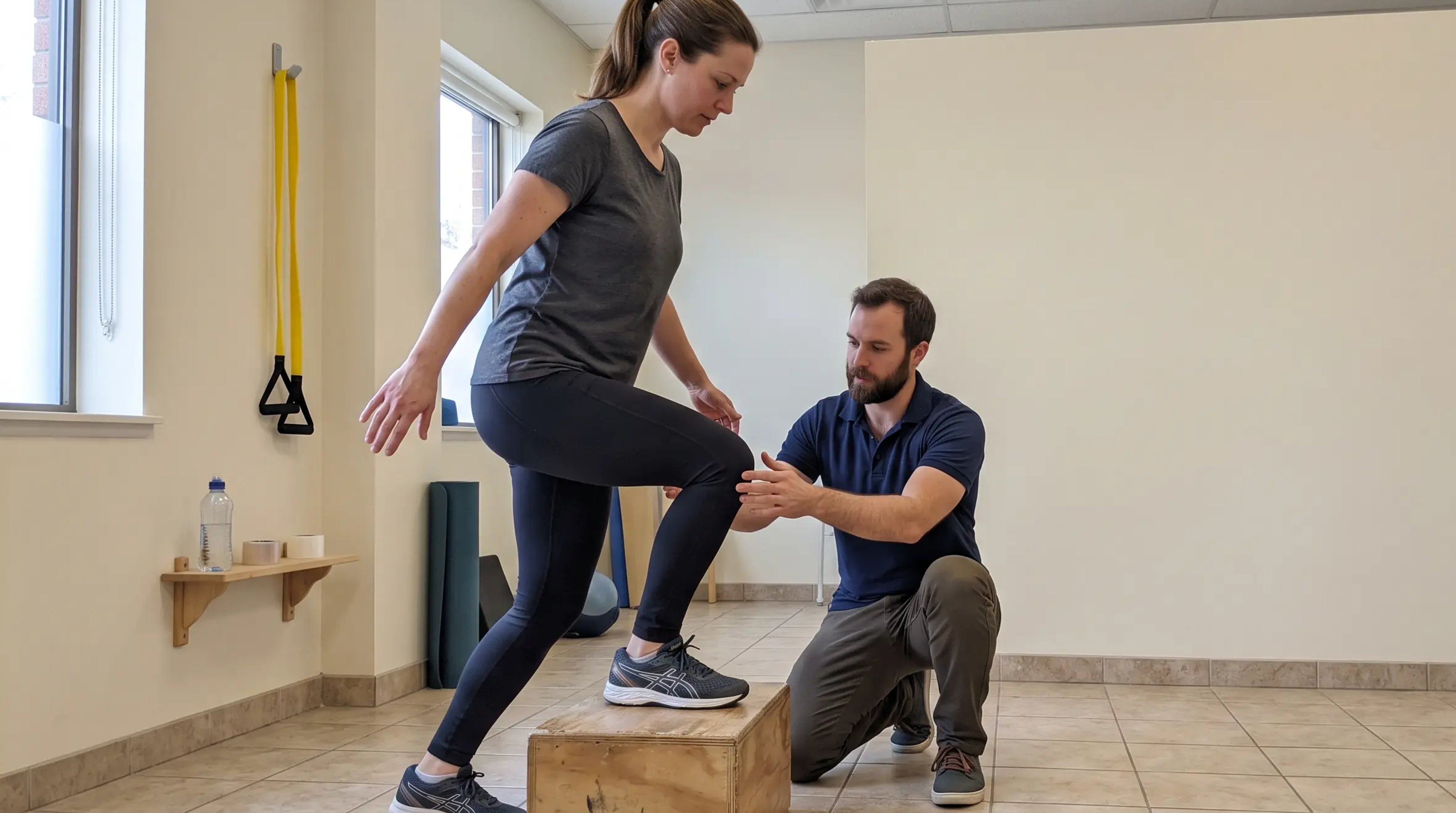

A meniscus tear on an MRI report and a meniscus tear that actually needs surgery are two different things. The scan shows a split in the cartilage. It does not show what your knee can still do, how much load it tolerates, or whether the thing catching inside it is a true mechanical block or a knee that is guarding because it hurts.
If you have had a scan come back with a tear and you are weighing surgery against rehab, this guide is for you, whether the tear came from a bad landing on court, a heavy squat, or years of running. You'll want to read this guide from Helen, our knee and post-surgical specialist, and a former competitive powerlifter herself. Here's what it covers: what a meniscus tear actually is, what the research says about surgery, and what treatment actually involves.
What a meniscus tear actually is
The meniscus is a wedge of tough cartilage that sits between your thigh bone and shin bone and spreads load across the knee. When it tears, that load-spreading job gets disrupted, which is why a torn meniscus can ache, swell, or catch when you load the joint a certain way. The tear itself is real. What it means for you depends almost entirely on the kind of tear it is and how your knee behaves around it.
Not all tears are the same, and the difference matters far more than the word "tear" suggests. Degenerative tears develop slowly, usually in people past their mid-thirties, as the cartilage wears and splits along its layers. Traumatic tears happen in a single moment, a twist, a bad landing, a heavy rep gone wrong, and they tend to show up in younger, active knees. The two behave differently and they point toward different decisions, which is why the label on the report is only the start of the conversation.
Part of the problem is that scans are noisy. Meniscus tears appear on the MRIs of plenty of people who have never had a day of knee pain, and that share rises steeply with age, from around 4% in adults under forty to somewhere between 19% and 43% once you are past it (Culvenor et al., 2019). A finding on a scan and a problem worth operating on are not the same thing, and the only way to tell them apart is to test what the knee can actually do under load.
Meniscus tears show up on the scans of plenty of people with no knee pain at all, and past the age of forty that can be true for as many as two in five.
If you just want to know whether physiotherapy can help with a meniscus tear, our meniscus tear page covers that in a couple of minutes. The rest of this guide is for the decision underneath it.
What the research says about surgery
This is where the biggest myths live, and where the evidence has shifted a long way from what people were told even a decade ago. Four beliefs come up in almost every consult, and each one is worth taking apart.
"A tear on the scan means I need surgery"
A tear on a scan is a finding, not a verdict. Because tears are so common in painless knees, the image alone cannot tell you whether surgery will help. In a sham-controlled trial, keyhole surgery for a degenerative tear worked no better than a fake operation for pain or function (Sihvonen et al., 2013). What decides your treatment is what your knee tolerates when you load it, not the wording on the report.
Across the strongest exercise-versus-surgery trials, people who rehabbed a degenerative tear ended up in the same place as those who had surgery, with the tear still sitting on the scan.
"Surgery is the faster, cleaner fix"
For degenerative tears, the best trials comparing exercise with keyhole surgery found no meaningful advantage to operating, and most people who rehabbed never went on to have surgery at all, roughly two-thirds in one trial and about four in five in another (the ESCAPE trial, Noorduyn et al., 2022; the OMEX trial, Kise et al., 2016). Trimming a meniscus also removes tissue that spreads load across the joint, tissue you do not get back, which can increase the pressure on the cartilage underneath. For a traumatic tear in a younger knee, repairing the meniscus can be the right call and preserves the joint better, but it means a longer recovery and potentially needing a second procedure (Paxton et al., 2011). And when researchers followed both groups for years, they found no statistically significant difference in who eventually needed a knee replacement (Katz et al., 2020).
"If I rest it, the tear will heal"
Rest calms an irritable knee, but it does not rebuild the capacity the joint needs, and most degenerative tears do not knit back together. They sit in the inner part of the meniscus, which has almost no blood supply and very little healing capacity. Only tears at the outer rim, where blood actually reaches, have much biological potential to heal on their own. When the pain settles, it usually means the joint has calmed down and the surrounding muscle has taken over the load, not that the tear has closed, which is why graded loading does more for most tears than time off ever will.
"My knee locks, so I have no choice"
There is a real difference between a knee that catches and a knee that is truly, mechanically locked. True locking is when a fragment physically blocks the joint so you cannot fully straighten the leg, and that does warrant a surgical opinion promptly. But catching, clicking, or a knee that guards because it is painful behaves very differently, and in the trials those symptoms improved just as well with rehab as with surgery. The distinction that matters is whether you can fully straighten the knee or something physically stops it.
What treatment actually involves
Whichever route you take, the work rests on the same three things. None of them require the tear to disappear first:
- Load tolerance. The core of the work is rebuilding strength through the knee, quads and hamstrings on both sides, so the tear stops being the weak link. That means heavy, controlled strength work, a staged return to squat depth, and single-leg control drills that rebuild trust in the joint. The tear does not have to close for the knee to get strong around it.
- Irritability. Swelling is the signal that tells us whether the dose is right. If the knee swells after a session or stays sore beyond a day, the load was too high and we scale it back rather than push through. As a rule of thumb, pain during activity that stays at 3 out of 10 or below and settles within 24 hours, with no rise in swelling, tells us the joint is handling the work.
- Return on criteria, not the calendar. We clear you based on what the knee can do, not on a date. That usually means at least 90% of the strength and control of your other leg, no lingering swelling, and, for cutting and pivoting sports, passing a set of single-leg hop tests that mirror the demands of the game.
A knee that swells after a session is telling you the dose was too high, not that you have done fresh damage.
The timeline depends on the route. Recovery from a keyhole trim is relatively quick, with runners often back to easy running within 9-12 weeks, while a repaired meniscus needs the tissue to heal biologically and pushes that out to around 5 to 6 months. Lifters returning after a repair usually have deep, loaded knee bend held back for the first 6 to 8 weeks to protect the stitched tissue. For most people with a degenerative tear who rehab rather than operate, the meaningful improvements tend to land somewhere between 8 and 12 weeks of consistent work. If you run, our guide for endurance athletes covers the return-to-running side in more depth.
The Bottom Line
A meniscus tear is a decision, not a sentence. The scan names the tear; your knee's capacity names the plan, and for a lot of tears, especially the degenerative ones, that plan starts and often ends with structured loading rather than surgery.
If you have a scan report in one hand and conflicting advice in the other, another opinion on the image is rarely what moves things forward. The useful next step is a proper look at what the knee tolerates under load.
Start there. Test what the joint can do, sort true locking from a knee that is simply guarding, and build the plan around the answer.
If you want a clear read on what your knee can actually handle and which way to go, you can book in with Helen below:

References
Culvenor, A.G. et al. (2019) 'Prevalence of knee osteoarthritis features on magnetic resonance imaging in asymptomatic uninjured adults: a systematic review and meta-analysis', British Journal of Sports Medicine, 53(20), pp. 1268-1278. doi:10.1136/bjsports-2018-099257
Katz, J.N. et al. (2020) 'Five-year outcome of operative and nonoperative management of meniscal tear in persons older than forty-five years', Arthritis & Rheumatology, 72(2), pp. 273-281. doi:10.1002/art.41082
Kise, N.J. et al. (2016) 'Exercise therapy versus arthroscopic partial meniscectomy for degenerative meniscal tear in middle aged patients: randomised controlled trial with two year follow-up', BMJ, 354, i3740. doi:10.1136/bmj.i3740
Noorduyn, J.C.A. et al. (2022) 'Effect of physical therapy vs arthroscopic partial meniscectomy in people with degenerative meniscal tears: five-year follow-up of the ESCAPE randomized clinical trial', JAMA Network Open, 5(7), e2220394. doi:10.1001/jamanetworkopen.2022.20394
Paxton, E.S., Stock, M.V. and Brophy, R.H. (2011) 'Meniscal repair versus partial meniscectomy: a systematic review comparing reoperation rates and clinical outcomes', Arthroscopy, 27(9), pp. 1275-1288. doi:10.1016/j.arthro.2011.03.088
Sihvonen, R. et al. (2013) 'Arthroscopic partial meniscectomy versus sham surgery for a degenerative meniscal tear', New England Journal of Medicine, 369(26), pp. 2515-2524. doi:10.1056/NEJMoa1305189
Written by Helen Nguyen | Founder and Musculoskeletal Physiotherapist, Activex Physio Singapore