
Shoulder pain in paddlers is usually a cumulative load problem rather than a single injury. The stroke places the shoulder under constant repetitive stress, and across hundreds to thousands of strokes per session, even small inefficiencies add up to more than the tissue can recover from. The pain tends to creep in over weeks rather than arriving in one bad session.
If your shoulder aches during sessions, flares after them, or has started dictating how you paddle, you'll want to read this guide that Nick wrote. He's our shoulder and paddle sports specialist, and he paddles competitively himself. Here's what it covers: what the paddle stroke demands of the shoulder, the four most common causes of paddler shoulder pain, why most paddlers make it worse, what actually helps, and when to see a physio.
What the Paddle Stroke Demands of the Shoulder
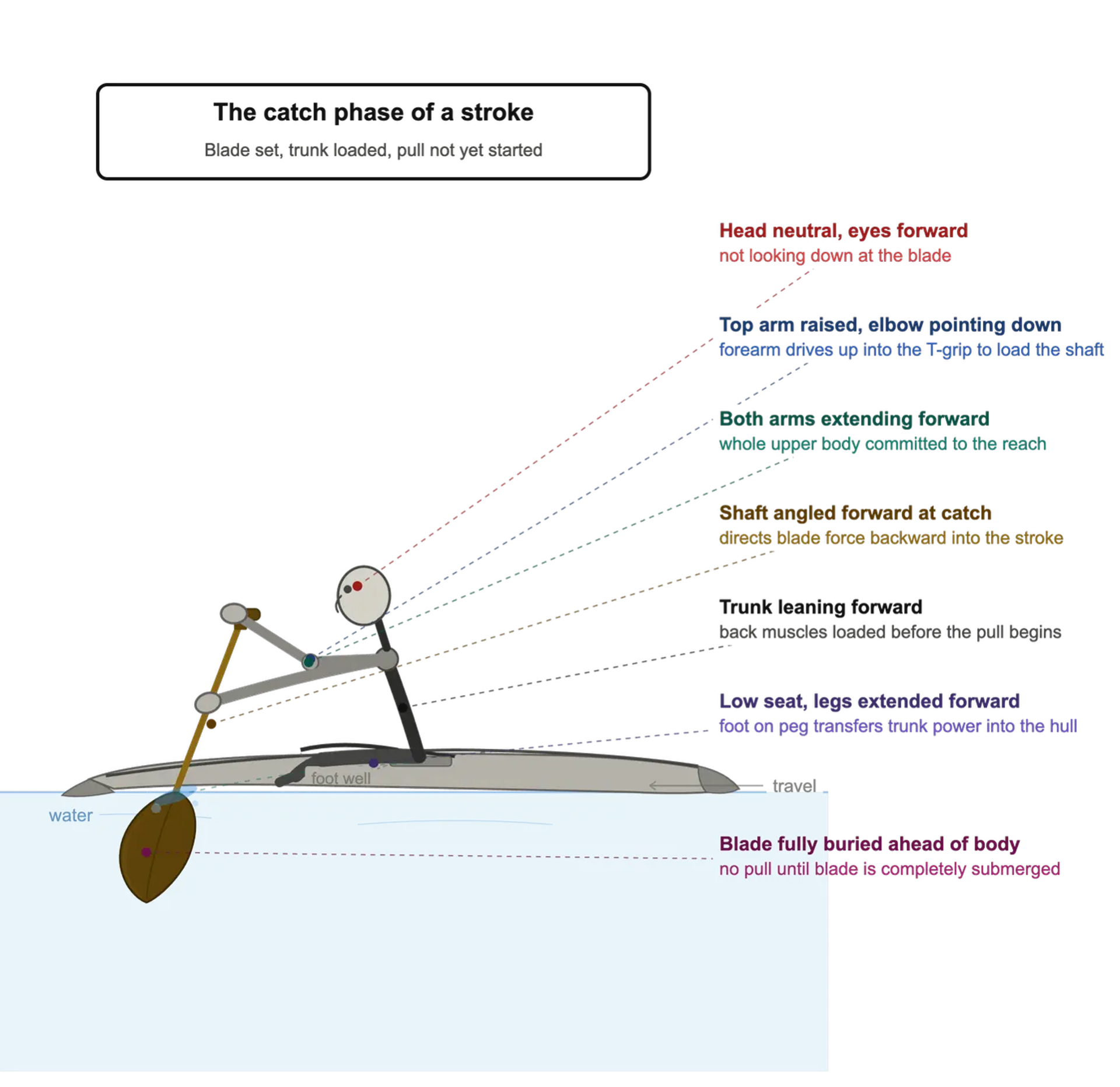
A paddle stroke is a full-body movement. The legs, trunk and core generate the power, and the shoulder's job is to transmit that force to the blade. Problems tend to start when the shoulder stops transmitting force and starts producing it.
That shift happens at predictable points in the stroke:
- At the catch. The shoulder is stretched forward, and the muscles around the shoulder blade have to stabilize it immediately, before the pull even begins.
- Through the pull. The big back muscles should dominate this phase. When they fatigue, the load shifts onto the arm and shoulder, and smaller structures start doing a job meant for bigger ones.
- At recovery. A tired shoulder starts compensating. It hikes up, trunk rotation reduces, and the arm ends up overworking to keep the boat moving.
None of these inefficiencies matters much on a single stroke. Across hundreds to thousands of strokes per session they compound, and that volume is what turns a small technical drift into an irritated tendon. The higher your weekly volume, the less room there is for those inefficiencies.
If you just want to know whether physio can help with a painful shoulder, our shoulder pain page covers that in two minutes.
The Four Most Common Causes of Paddler Shoulder Pain
Four conditions cover most of the shoulder pain paddlers deal with. The list isn't exhaustive, but these are the most prevalent:
- Shoulder impingement. A pinching or sharp pain when you lift your arm forward or out to the side. It's usually not a structural problem at its origin; poor shoulder control lets the joint move poorly under load, and the tendons get compressed with every stroke. At paddling volumes, that compression becomes irritation.
- Rotator cuff tendinopathy. A deep ache that gets worse when you reach forward under resistance or rotate the arm outward against force. The rotator cuff muscles are small and don't generate big power, so they're easily overworked when physical demand spikes: a new season, a return from a break, extra sessions added to the week. The tendons are overloaded from repetitive pulling rather than structurally torn.
- Posterior shoulder tightness. Often painless on its own, which is what makes it easy to miss. The back of the shoulder stiffens, the arm feels restricted reaching across the body (the seatbelt reach is the classic one), and the reduced mobility drives impingement and tendon overload secondarily. It's common in long-term paddlers, usually on the dominant arm, and the pain shows up at the front or top of the shoulder rather than at the tight area itself.
- Biceps tendon irritation. A deep aching pain at the front of the shoulder, worse at the catch with a straight-arm pull, which is why it's common in dragon boat and OC paddlers. The biceps tendon gets overloaded working as a secondary stabilizer when the rotator cuff is fatigued.
These four rarely show up in isolation. Impingement and rotator cuff tendinopathy frequently co-exist, posterior tightness can quietly drive both, and pinning down the actual driver from symptoms alone tends to go wrong.
The pain often shows up at the front of the shoulder while the driver hides at the back.
Why Most Paddlers Make It Worse
Shoulder pain pushes paddlers into a handful of standard responses. Four come up again and again, and each one keeps the problem alive in its own way:
- Paddling through it. Training through the pain maintains your fitness, but it never gives the tendon a chance to recover, and small problems quietly become bigger ones.
- Complete rest. Stopping entirely feels like the responsible option, but tendons lose capacity when they aren't loaded. You return to full training with a weaker shoulder than the one you rested, and the re-injury cycle starts.
- Living on resistance bands. Bands provide too little load to drive real muscular adaptation, and they usually miss the actual driver of the pain, which is often poor shoulder blade control and reduced trunk rotation.
- Aggressively stretching the painful shoulder. Forcing range into an irritated shoulder can further aggravate the structures inside it and leave you with a more sensitive joint than you started with.
Complete rest costs the tendon capacity, which is why stopping entirely so often ends in the re-injury cycle.
What Actually Helps
The fix runs in three phases, and none of them involves stopping completely. The order matters: settle the load first, address the deficits underneath it, then rebuild for the specific demands of paddling.
Phase 1: Reduce the Load, Don't Eliminate It
The first job is finding a level of paddling your shoulder tolerates, because tendons recover better under manageable load than under none at all.
- Find your tolerable volume. Reduce intensity or session duration until the shoulder settles during and after paddling, rather than stopping outright.
- Modify your technique. Increasing the trunk rotation contribution to the stroke offloads the shoulder directly, stroke by stroke.
- Switch it up temporarily. A short block in a different discipline, or more ergo work to maintain pull-dominant fitness while the shoulder recovers, keeps you training without feeding the irritation.
Phase 2: Address the Deficits
Once the shoulder has settled, the work shifts to whatever let it get overloaded in the first place.
- Shoulder blade control. Wall slides, prone Y raises and bear position holds rebuild the control that keeps the joint moving well under load.
- Posterior tightness. Targeted stretching of the back of the shoulder, ideally physio-guided, restores the mobility that was quietly driving the overload.
- Rotator cuff loading. Start with side-lying outward rotation and progress into resisted positions as the tendon tolerates more.
If you want a broader look at building shoulder capacity beyond the boat, Nick's guide on why overhead strength matters covers it.
Phase 3: Rebuild for Paddling
The final phase makes the new strength specific to the stroke:
- Rotation core work. The trunk is the force transfer point for the stroke, and building rotational strength there sends the shoulder back to its real job of transmitting force rather than producing it.
- Paddle-specific pulling strength. Single-arm pulling with trunk rotation, progressively loaded, mirrors what the stroke actually asks of the shoulder.
- A structured return to the water. Build volume back gradually rather than jumping straight into full sessions.
When to See a Physio
A lot of paddling shoulder pain responds to the approach above, but a few patterns are worth professional eyes sooner rather than later:
- No improvement after two weeks of load reduction. If cutting back hasn't shifted anything in two weeks, something else is likely driving the pain.
- Night pain or pain at rest. Pain that doesn't need movement to show up can indicate a structural issue that needs imaging.
- Weakness rather than pain. Gross weakness in the arm points towards a possible tendon tear rather than a tendinopathy, and that changes the management entirely.
- Months of bands and stretching with no change. If that's been the program and nothing has moved, the most likely explanation is that the wrong driver is being treated.
The Bottom Line
Shoulder pain in paddlers is common, rarely permanent, and usually fixable without stopping paddling completely. The root causes come down to too much load, poor shoulder blade and trunk control, and technique drift, and all three respond to the right work.
If your shoulder has been flaring for a few weeks and easing off hasn't settled it, it's worth working through the causes above rather than waiting it out.
Start by finding the volume your shoulder tolerates, shift more of the stroke's work onto your trunk, and rebuild from there. That's the route back to full sessions on the water.
If you want eyes on your shoulder and a clear picture of what's driving it, you can book in with Nick by clicking the link below:

Written by Nicholas Ho (Nick) | Physiotherapist, Paddle Sports & Upper Limb Specialist, ActiveX Physio Singapore