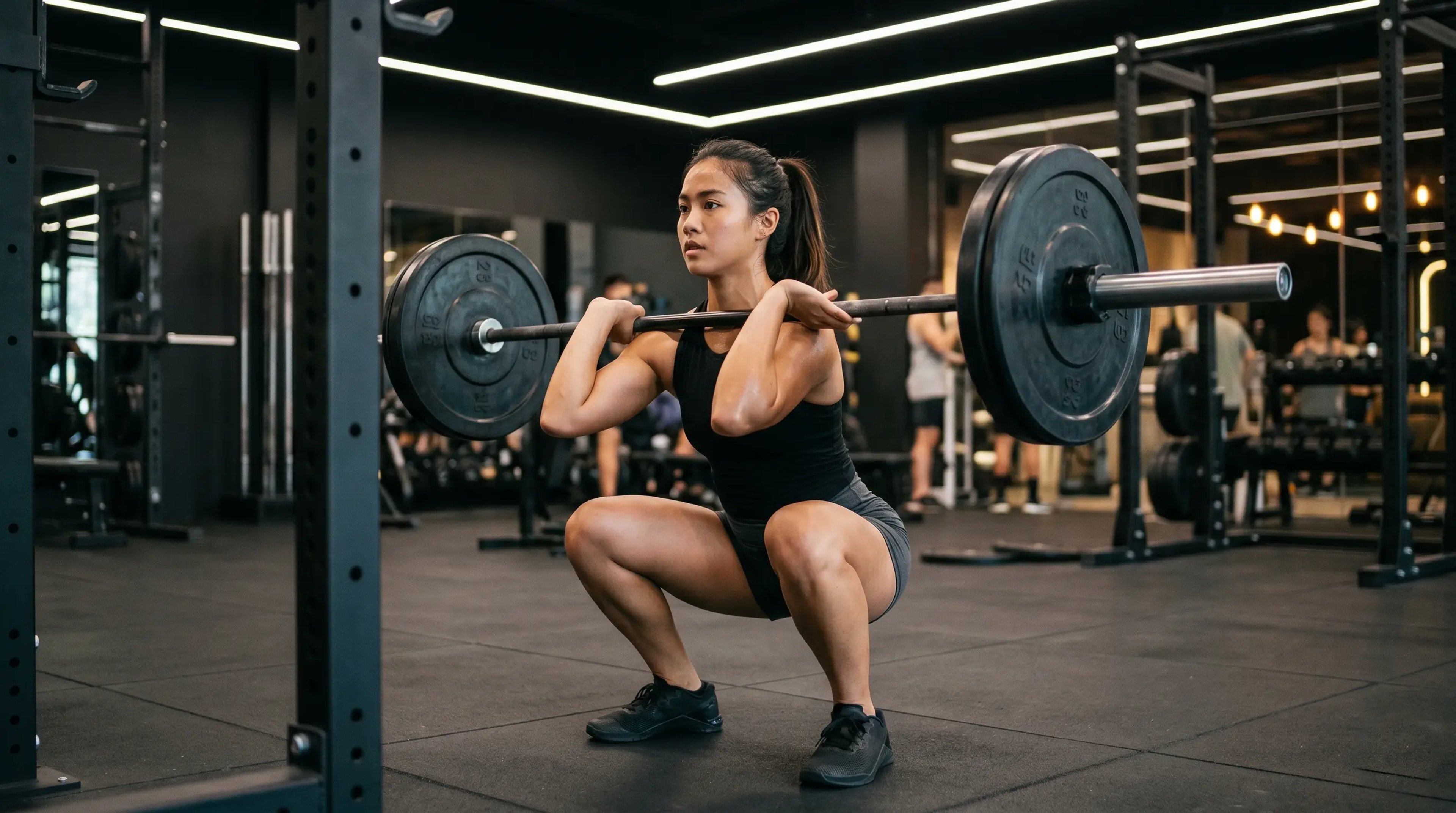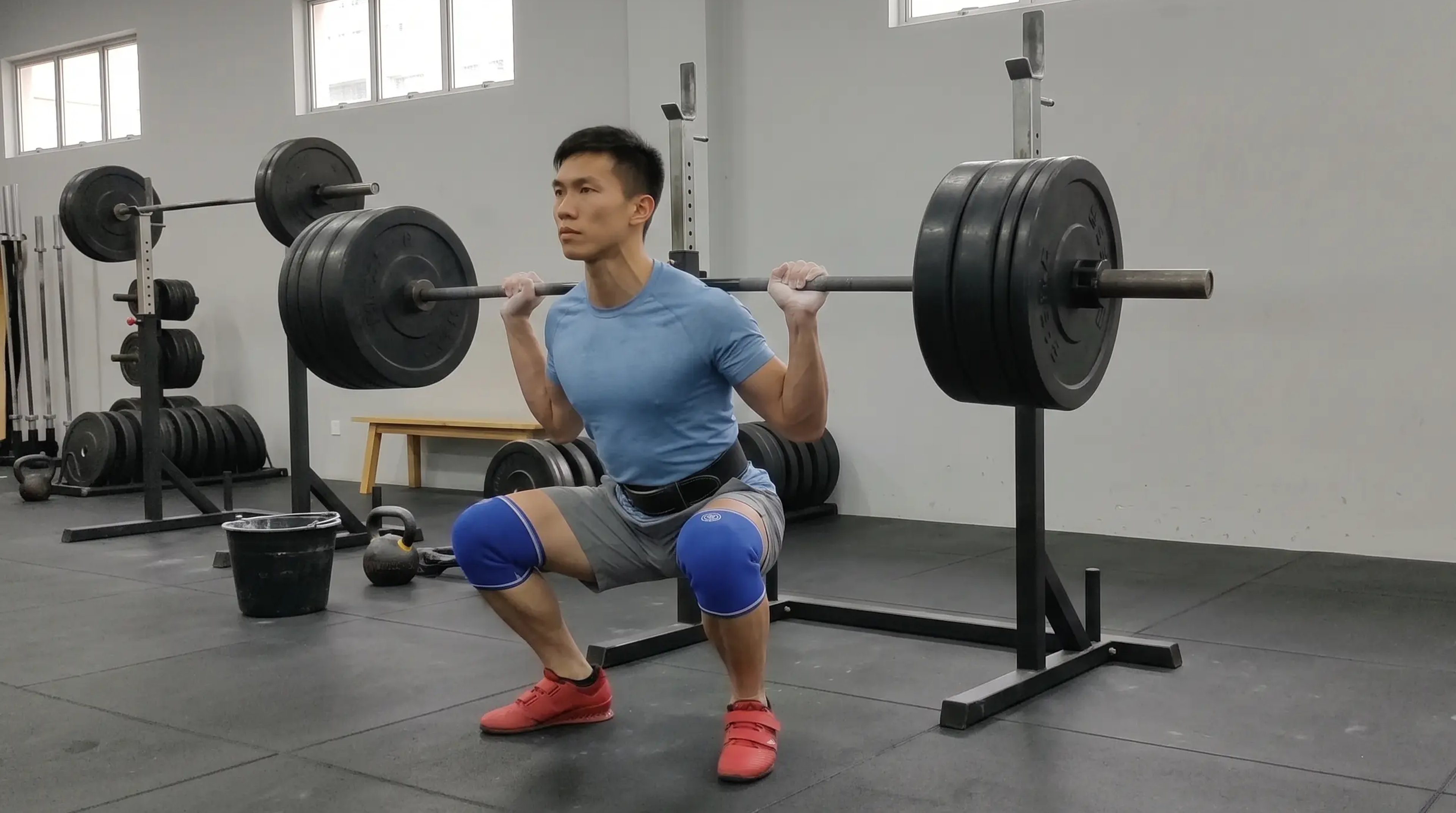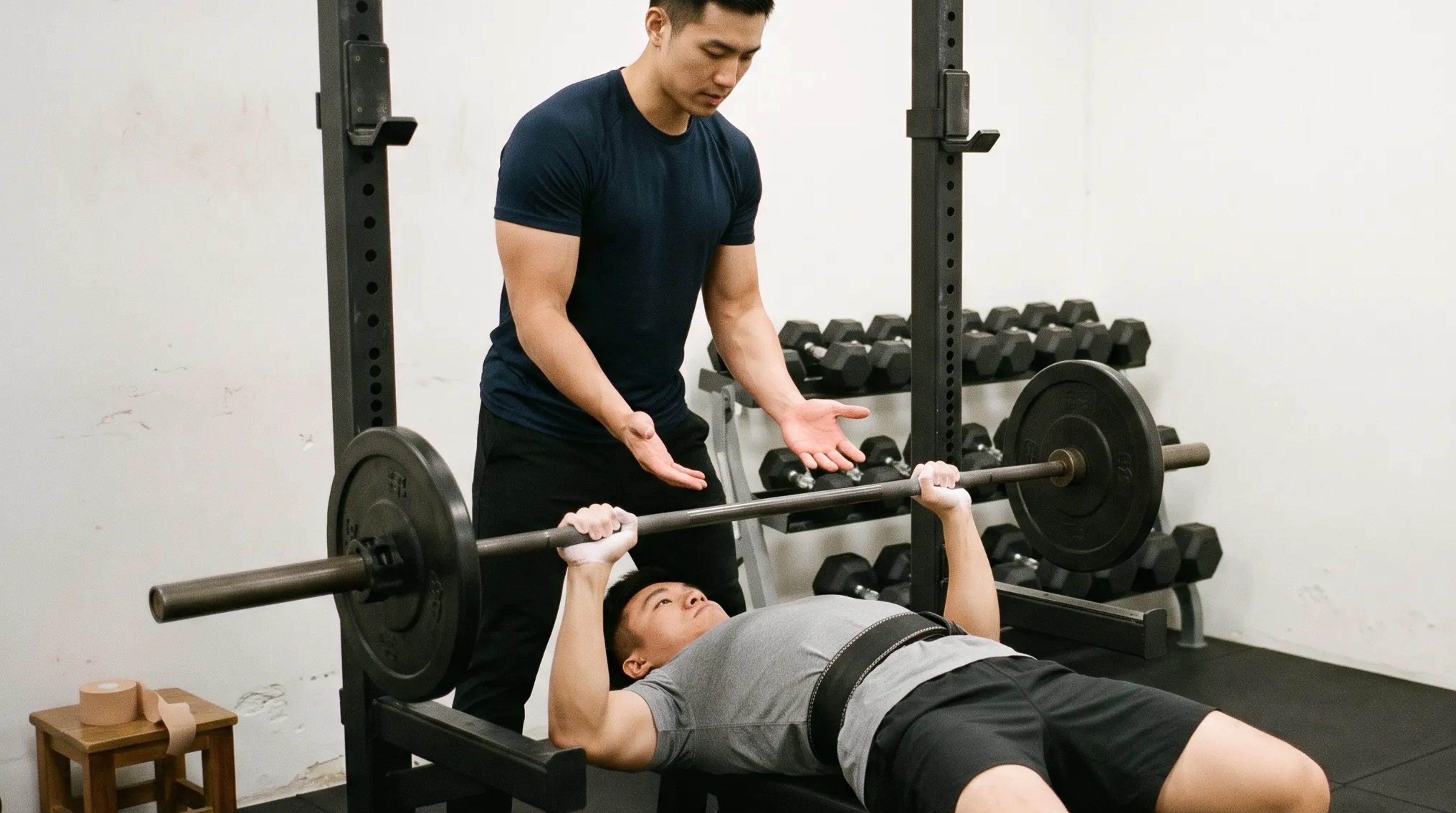

Most shoulder pain from benching or overhead pressing happens because the shoulder is doing more than it is currently ready for, and it rarely means the joint is damaged. That is good news, because what your shoulder is ready for can be trained.
If your shoulder has started to hurt when you bench or press overhead, this guide, written by our physiotherapist TJ, lays out the four conditions that show up most in lifters and how to keep training while it settles. Here's what it covers: why your shoulder hurts when you press, whether it is serious and you need to stop, rotator cuff related shoulder pain, AC joint pain, long head of biceps tendinopathy, pec major strains and tears, scapular dyskinesis, your plan for the next few weeks, and when to see a physio.
Why your shoulder hurts when you press
The shoulder is a small joint doing a big job when you press. At the bottom of a heavy bench, it is stretched back behind your body while holding the bar. Overhead, it has to move through its full range with the weight directly above it. Add another variable, such as a competition prep, extra pressing sessions or a new grip, and the shoulder can struggle to keep up, which is often when pain starts.
If you just want to know whether physio at Activex Physio in Singapore can help with your shoulder, our shoulder pain page covers that in two minutes. The rest of this guide goes deeper.

Is it serious, and do you need to stop?
Usually not, on both counts. The research on powerlifters and weightlifters points to three things that matter when your shoulder hurts:
- It is common. The shoulder is a top three injury site in both sports (Aasa et al., 2017). Pain when you press does not mean something unusual is going on.
- It is usually an overload problem. The most common injuries in strength sports are strains, sprains and irritated tendons, and heavy loads with frequent bench and overhead pressing may be the driver (Keogh and Winwood, 2017). So the fix sits in your training: load, range, grip and what you build around the press.
- Most lifters keep training. Among ranked Swedish powerlifters carrying an injury, only 16% stopped training completely (Strömbäck et al., 2018). In elite weightlifters, over 90% of injuries cost less than a day off (Aasa et al., 2017). Modifying works better than resting.
The exception is a sudden pop with bruising, covered in section 4.
Among ranked Swedish powerlifters carrying an injury, only 16% stopped training completely, and in elite weightlifters over 90% of injuries cost less than a day off.

1. Rotator cuff related shoulder pain
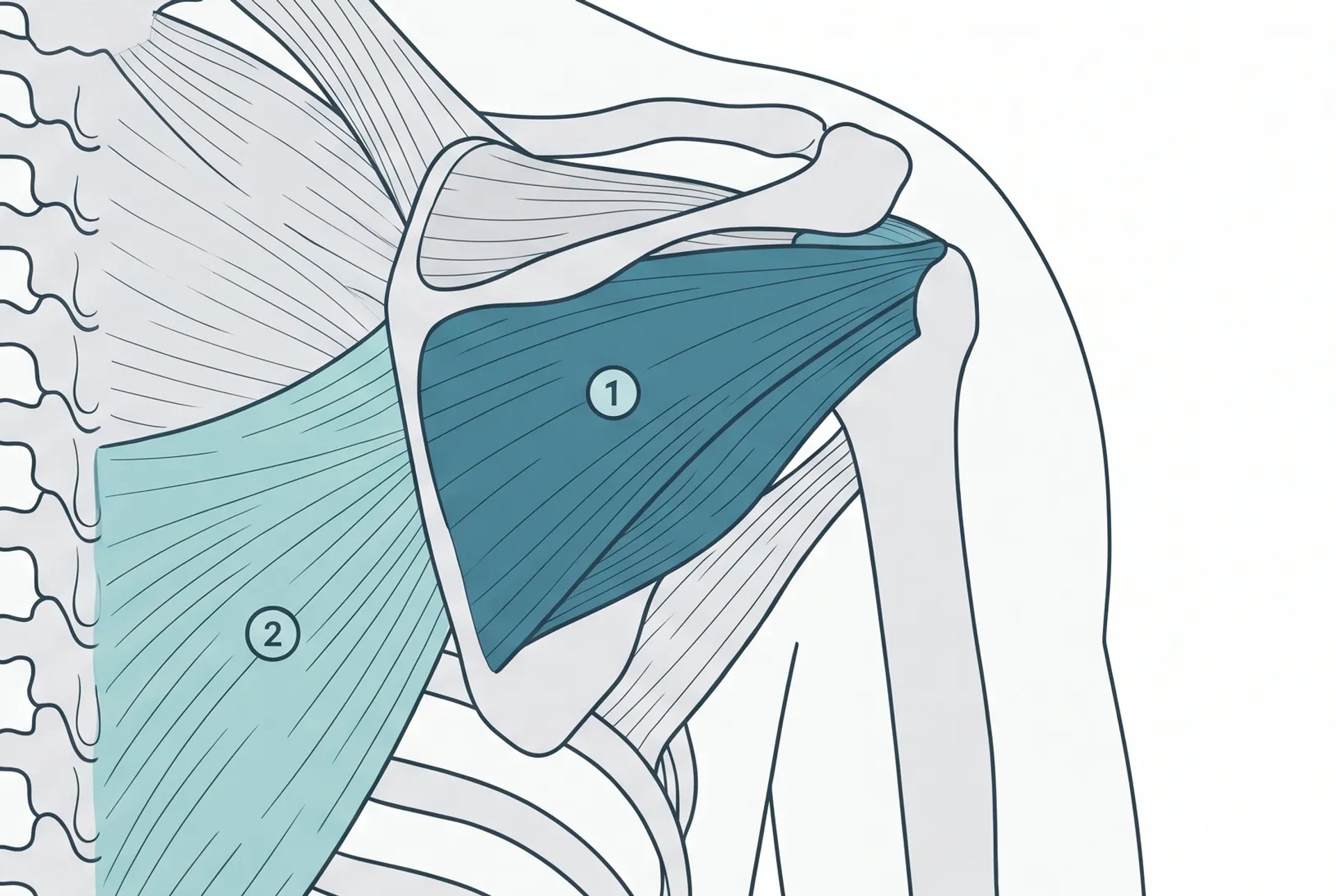
This is the most common one. The rotator cuff is a group of small muscles that keep the ball of your shoulder centered in its socket, and their tendons are being asked to do more than they are ready for. You may have heard it called impingement. That name suggests something is being pinched, but in lifters it behaves like an overloaded tendon, and it gets better with the right kind of loading.
In lifters, the pain often called impingement behaves like an overloaded tendon, and it gets better with the right kind of loading.
What it feels like
- An ache at the front or side of the shoulder, sometimes spreading to the outside of the upper arm
- Pain when you lift your arm out to the side
- On the overhead press, pain as the bar passes your forehead or at the top
- On the bench, pain at the bottom or at the hardest part of the lift
- Aching after the session, or when lying on that side at night
Why lifters get it
Lifters with this problem tend to have weaker external rotators (the muscles that turn your arm outward) and lower traps (the muscles that help control your shoulder blade), and less rotation range, than lifters without pain. The researchers suggest that programs focused heavily on the chest and shoulders, while neglecting these smaller stabilizing muscles, add to the problem (Kolber et al., 2017).
What usually helps
Keep benching and pressing, but change how you do it for now:
- Bench: use a closer grip. This shifts more of the work onto your triceps and less onto the front of your shoulder.
- Bench: shorten the range for a few weeks. Pin presses (pressing up from safety pins set just above your chest), Spoto presses (pausing 2 to 3 cm above your chest) and board presses all cut out the bottom of the bench, where the shoulder is under the most stress.
- Overhead press: change the angle. For a few weeks, swap to a landmine press (one end of a barbell anchored in a corner and pressed up at an angle) or a high incline press, so your arm is not going fully overhead under load. Keep lateral raises below shoulder height for now.
- Overhead press: try dumbbells. Pressing with your palms facing each other and your elbows slightly in front of you is often more comfortable than a barbell.
Alongside these changes, build up what is missing. Lifters with this problem usually need more strength in the muscles that turn the arm outward and inward, and in the muscles that control the shoulder blade. Train them two to three times a week with light weights and higher reps, through a range that does not hurt, and work toward your painful side matching your good side. Which exercises suit you depends on what your shoulder is actually missing, so this part is worth having assessed rather than guessed.
Drop the weight on your bench and overhead press to a level where pain stays at 4 out of 10 or less and settles by the next morning. Then build back up gradually, as the plan below explains.
2. Acromioclavicular (AC) joint pain (a.k.a. weightlifter's shoulder)
Pain sitting right on top of the shoulder, at the bony bump where the collarbone meets the shoulder blade, is usually the AC joint, and the bench is the classic trigger.
What it feels like
- Pain you can point to with one finger, on top of the shoulder
- Worse at the bottom of the bench, on dips and on push-ups
- Reaching across your body, like touching the opposite shoulder, hurts
- Sometimes sore when the bar rests on the front of your shoulders, like in a front squat or clean
Why lifters get it
Heavy, repeated loading through the AC joint can make the end of the collarbone start to break down, a condition called distal clavicle osteolysis. In a study of adults with it, 56% were benching more than 1.5 times their bodyweight, compared with 6% of people without it. Lighter benching was not linked to it, but benching more than once a week, or for more than five years, was (Nevalainen et al., 2016). In a modeling study of experienced strength athletes, very wide grips put more compression through the AC joint than narrower ones (Noteboom et al., 2024).
In adults with distal clavicle osteolysis, 56% were benching more than 1.5 times their bodyweight, compared with 6% of people without it.
What usually helps
- Avoid very wide grips, but find your own width. A wide grip loads the AC joint more, but going very close can irritate it too. Try a few widths with a light weight and keep the one that feels best.

- Stop the bar short of your chest. For two to three weeks, bench to a folded towel or a board on your chest, so the last few centimeters are taken out.
- Take out dips and deep flyes for now. They load the same joint in the same stretched position.
- Keep overhead pressing if the top of your shoulder stays comfortable during it.
- Get it checked if it keeps coming back. An X-ray can show whether the bone is involved.
What if an X-ray shows bone changes?
It sounds worse than it is. It means the end of the collarbone has been overloaded for a while, not that the joint is ruined. Most cases still settle with the changes above, though bone can take longer to settle than a tendon. If it does not, keyhole surgery to trim the end of the collarbone is an option, and lifters usually get back to training quickly afterwards.
3. Long head of biceps tendinopathy
Pain at the front of the shoulder that runs into the biceps is often an irritated biceps tendon. It tends to be worst at the bottom of the bench, and it can flare with overhead pressing too. The long head of the biceps tendon runs through a groove at the front of the shoulder and takes a lot of load when your arm is taken back behind you under a heavy bar.
What it feels like
- Pain at the front of the shoulder, sometimes running down the front of the upper arm
- A tender spot when you press on the front of the shoulder
- Worst when the bar touches your chest, especially with a wide grip, or in the stretch of a dip
- Pain at the front of the shoulder as you press up overhead
- Can also flare with heavy curls or chin-ups

Why lifters get it
The bottom of the bench takes the shoulder back behind the body under load, which puts the front of the joint under the most stress. In a modeling study of experienced lifters, a narrower grip with the shoulder blades set back lowered the load on the shoulder joint (Noteboom et al., 2024). Overhead pressing loads the same tendon as your arms drive up in front of you, so heavy or frequent pressing can irritate it too.
What usually helps
How this differs from rotator cuff pain: rotator cuff pain is mostly about building up the small muscles that steady the shoulder. Here the irritated tendon belongs to the biceps, so the priority is taking load off the biceps and out of stretched positions first, then building it back up.
- Shorten the bench range. For two to three weeks, use a Spoto press, board press or floor press (benching while lying on the floor, which stops your elbows short), then work back to touching your chest. When you return to the barbell, bring your grip in.
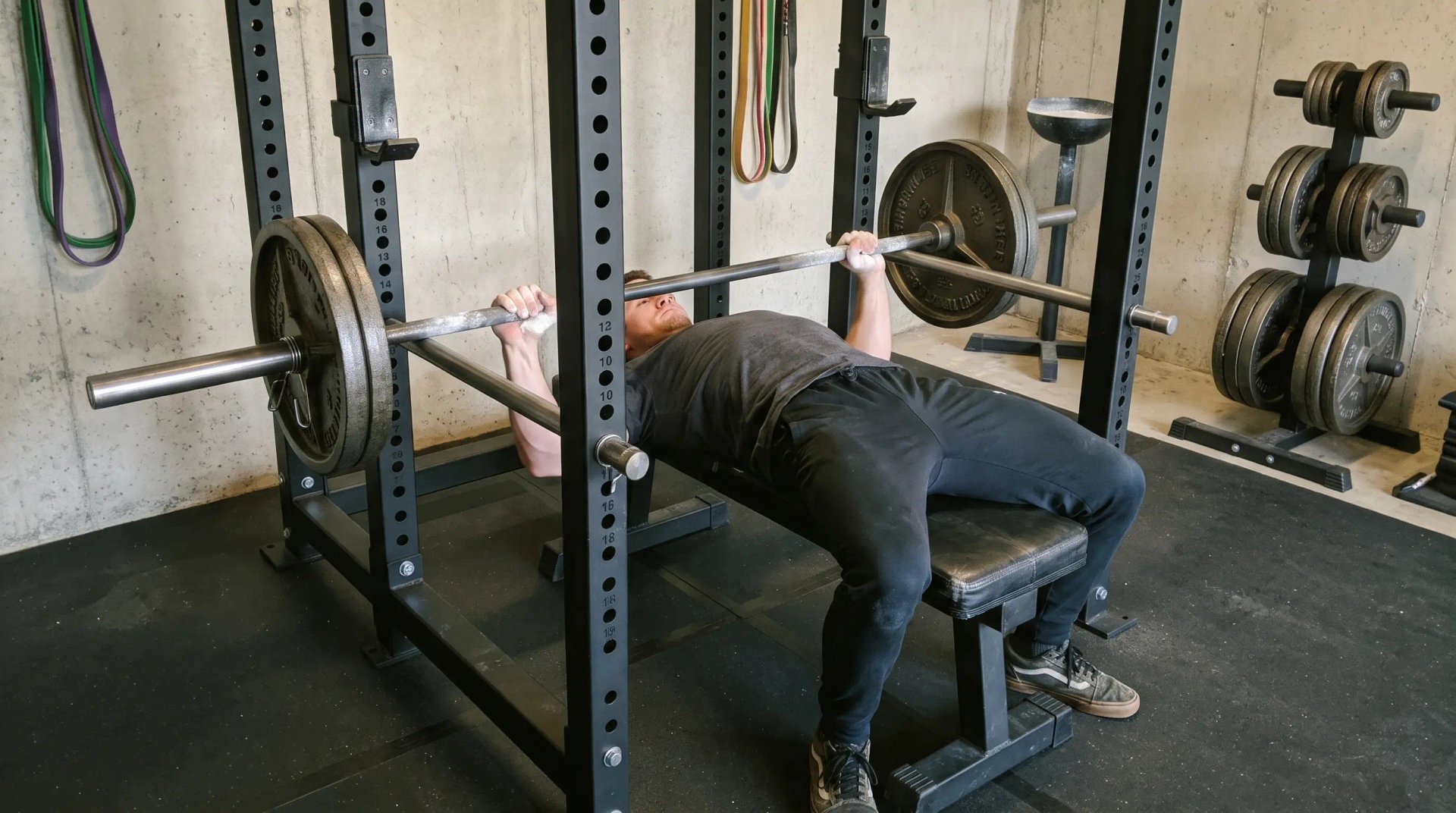
- Use a neutral grip. On the bench and overhead, press with dumbbells, palms facing each other, or a Swiss bar (a bar with handles that let your palms face each other). This keeps the front of the shoulder out of the position that irritates the tendon.
- Change your overhead press. For a few weeks, swap the barbell overhead press for a landmine press, and only press through the range that does not hurt.
- Ease off heavy curls and chin-ups for a couple of weeks, then build them back up gradually.
- Keep rowing. Keep training rowing variations that do not hurt, so your upper back keeps working while the tendon settles.
A clunk or catching feeling at the front of the shoulder is worth getting assessed rather than managing on your own.
4. Pec major strain or tear: the one not to train through
A sudden pop or tearing feeling at the bottom of a heavy bench, followed by bruising, needs to be seen within days, not trained around. This is the least common of the four, but the one where timing matters most.
What it feels like
- A pop, snap or tearing sensation, usually on a heavy rep or as the bar comes down
- Bruising across the chest, armpit or upper arm over the next day or two
- The fold at the front of the armpit looks different, or the muscle looks bunched up
- Weakness pushing or bringing the arm across the body
Why lifters get it
Over half of pec major ruptures happen in athletes, classically during the bench press (Kakwani et al., 2007). A muscle is most likely to tear when it is stretched and working hard at the same time, and the bottom of a heavy bench is exactly that for the pec. Your arm is out wide and back, so the pec is at full stretch, while it works its hardest to slow the bar down and stop it. If that load is more than the tendon can handle, it can tear where it attaches to your upper arm.
What usually helps
Minor strains in the muscle respond well to building the load back up gradually. Full tendon tears are different: surgery generally restores more strength than leaving it to heal on its own, and earlier repair may give better results. Either way, the decision is easier when the assessment happens early.
What about scapular dyskinesis?
Scapular dyskinesis (often searched as scapular dyskinesia) means your shoulder blade moves differently from what is considered typical, for example tipping forward, sticking out or shrugging early as you lift your arm. It describes a movement pattern, not damage, and it is common in people with no pain at all. One study found it just as often in pain-free shoulders as in painful ones (Plummer et al., 2017).
Scapular dyskinesis turns up just as often in pain-free shoulders as in painful ones.
That does not mean how your shoulder blade moves never matters. In pain-free athletes, it was linked to a higher chance of developing shoulder pain later, although most of them never did (Hickey et al., 2018). It also shows up in pressing. If your shoulder blades cannot stay set back at the bottom of the bench, the shoulder joint and rotator cuff take more of the load (Noteboom et al., 2024). If they do not rotate upward as the bar goes overhead, the rotator cuff may have to work harder.

How the label is handled matters just as much. Diagnostic labels shape how people see their shoulder, and in one trial some labels made people feel more in need of surgery (Zadro et al., 2021). So if you have been told your shoulder blade is "dysfunctional", treat it as one trainable piece of the picture, not a broken part.
A physio can check whether changing how your shoulder blade moves actually changes your pain while you press. If it does, it is worth training. If it does not, it is probably not the main problem.
Your plan for the next few weeks
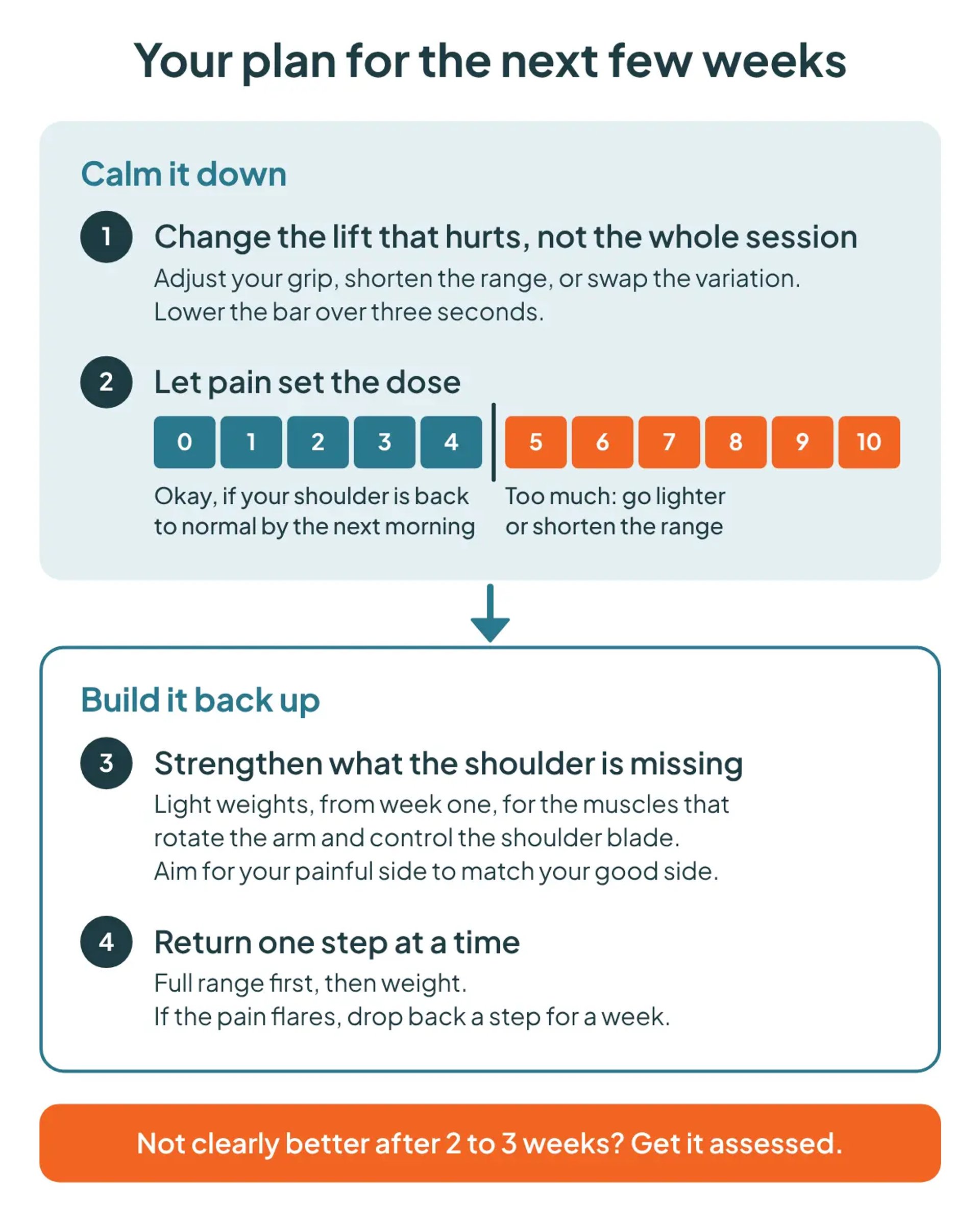
Everything above comes down to two principles: calm the shoulder down, then build it back up. You do not need to know exactly which condition you have to start, and you do not need to stop training.
Calm it down
Step 1. Change the lift that hurts, not the whole session. Find where it hurts from the list in The Bottom Line below and go to that section. Its changes usually come down to adjusting your grip, shortening the range, or swapping to a friendlier variation for a few weeks. Lowering the bar slowly and under control, for example over three seconds, can also help. Keep training everything that does not hurt.
Step 2. Let pain set the dose. Some discomfort is fine. Rate your pain out of 10 while you lift: 4 or below is okay, as long as your shoulder feels back to normal by the next morning. If it is worse the next day, go lighter or shorten the range next session. If the pain started after you added sets or sessions, cut your pressing volume by about a third for a week or two.
Pain at 4 out of 10 or below while you lift is okay, as long as your shoulder feels back to normal by the next morning.
Build it back up
Step 3. Strengthen what the shoulder is missing. Lifters with shoulder pain are often strong in the chest and front of the shoulder, but weak in the smaller muscles that rotate the arm and control the shoulder blade. Start building these in week one with light weights, as described in the rotator cuff section, and aim for symmetry: work toward your painful side matching your good side, which can be especially helpful for rotator cuff pain.
Step 4. Return one step at a time. Each week the pain rule holds, take one step back toward your normal training: full range first, then weight. If a different grip feels better, keep it. If the pain flares, drop back a step for a week. If you are not clearly improving after two to three weeks, get it assessed.
When to see a physio
- A pop, bruising, or a change in the shape of the chest or armpit fold
- The shoulder clunks, slips or feels unstable
- Clear weakness, or you cannot lift the arm
- Pain that wakes you most nights
- Pins and needles, numbness or pain running down the arm, which can come from the neck
- No real improvement after two to three weeks of modifying your training
See a doctor the same day if shoulder pain comes with chest pain, breathlessness, fever or a visible deformity.
The Bottom Line
Shoulder pain from benching and overhead pressing is common, it is usually an overload problem, and most lifters can keep training while it settles. Where it hurts points to the likely cause:
- Front or side of the shoulder. Usually the rotator cuff. Use a closer grip and shorter range on the bench, press at an angle instead of straight overhead, and strengthen the small muscles that rotate and steady your shoulder.
- On top of the shoulder. Usually the AC joint. Avoid very wide grips, stop short of your chest and drop dips and flyes for now.
- Front of the shoulder into the biceps. Usually the biceps tendon. Take load off the biceps with a shorter range, a neutral grip on the bench and overhead, and lighter curls, and keep rowing pain-free.
- A sudden pop with bruising. Possibly a pec tear. Get it checked within the week.
- Told you have scapular dyskinesis. A trainable movement pattern, not damage. It is worth working on if changing it changes your pain.
Whichever it is, the plan can start with this: calm it down, then build it back up, with pain as your guide. If it is not clearly better after two to three weeks, get it assessed. Your shoulder is underprepared for what you are asking of it, and that is something you can train.
If you want eyes on your shoulder and a clear picture of what's driving the pain under the bar, you can book in with TJ from our pricing page here.
References
Aasa, U. et al. (2017) 'Injuries among weightlifters and powerlifters: a systematic review', British Journal of Sports Medicine, 51(4), pp. 211-219. Available at: https://bjsm.bmj.com/content/51/4/211
Hickey, D. et al. (2018) 'Scapular dyskinesis increases the risk of future shoulder pain by 43% in asymptomatic athletes: a systematic review and meta-analysis', British Journal of Sports Medicine, 52(2), p. 102. Available at: https://bjsm.bmj.com/content/52/2/102
Kakwani, R.G. et al. (2007) 'Rupture of the pectoralis major muscle: surgical treatment in athletes', International Orthopaedics, 31(2), pp. 159-163. Available at: https://pmc.ncbi.nlm.nih.gov/articles/PMC2267574/
Keogh, J.W.L. and Winwood, P.W. (2017) 'The epidemiology of injuries across the weight-training sports', Sports Medicine, 47(3), pp. 479-501. Available at: https://research.bond.edu.au/en/publications/the-epidemiology-of-injuries-across-the-weight-training-sports/
Kolber, M.J. et al. (2017) 'Shoulder joint and muscle characteristics among weight-training participants with and without impingement syndrome', Journal of Strength and Conditioning Research, 31(4), pp. 1024-1032. Available at: https://scholars.nova.edu/en/publications/shoulder-joint-and-muscle-characteristics-among-weight-training-p/
Nevalainen, M.T. et al. (2016) 'Distal clavicular osteolysis in adults: association with bench pressing intensity', Skeletal Radiology, 45, pp. 1473-1479. doi:10.1007/s00256-016-2446-z
Noteboom, L. et al. (2024) 'Effects of bench press technique variations on musculoskeletal shoulder loads and potential injury risk', Frontiers in Physiology, 15, 1393235. doi:10.3389/fphys.2024.1393235
Plummer, H.A. et al. (2017) 'Observational scapular dyskinesis: known-groups validity in patients with and without shoulder pain', Journal of Orthopaedic and Sports Physical Therapy, 47(8). Available at: https://pure.johnshopkins.edu/en/publications/observational-scapular-dyskinesis-known-groups-validity-in-patien/
Strömbäck, E. et al. (2018) 'Prevalence and consequences of injuries in powerlifting: a cross-sectional study', Orthopaedic Journal of Sports Medicine, 6(5), 2325967118771016. Available at: https://pmc.ncbi.nlm.nih.gov/articles/PMC5954586
Zadro, J.R. et al. (2021) 'Diagnostic labels for rotator cuff disease can increase people's perceived need for shoulder surgery: an online randomized controlled trial', Journal of Orthopaedic and Sports Physical Therapy. Available at: https://ses.library.usyd.edu.au/handle/2123/35171
Written by Tian Jie (TJ) Chen | Physiotherapist & Strength Sports Specialist, Activex Physio Singapore